
There are real issues in Scotland’s relationship with the BBC. With charter renewal round the corner in 2027, it is time for a national conversation about what is and isn’t working and what Scotland wants for its broadcasting future.
The BBC has some successes to boast. A second series of Scotland’s first-ever big-budget Gaelic drama An t-Eilan, The Island, made by Glasgow-based Black Camel Productions, has just been greenlit.
The series would not have happened without investment from the BBC and Screen Scotland. It is demonstrating that Gaelic drama can win global attention and bring a return. The first four episodes are being shown in countries across the world.
But this does not outweigh the concerns.
“I’m selling my guitar and this is why”
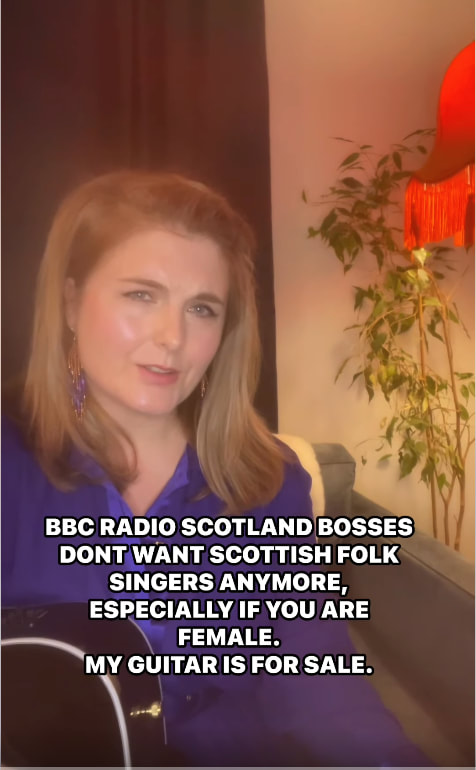
One group of BBC critics are Scottish musicians who have been protesting the axing of several curated, late-night music shows.
After specialist music programmes hosted by Iain Anderson, Billy Sloan, Roddy Hart and Natasha Raskin Sharp were taken off air, folk musician Stephen McAll, of Constant Follower, went back through every late-night playlist from January 1 to 15, 2025, then did the same for the same period this year.
The Herald reported McAll’s results – he found the number of new tracks by Scottish artists played fell by two-thirds. Folk singer Vivien Scotson responded with the social media post above. (The BBC said the stats seemed drawn from a small section of output).
McAll said: “The reality is, in Scotland, the one space where emerging artists could get that first significant play was these late-night shows on BBC Radio Scotland.
“When I started recording, I was absolutely broke. So what did I do? I recorded a song and I sent it to Vic Galloway and Roddy Hart. They played it and they said something nice about it.
“That gave me something I could use, proof that my music was worth paying attention to. I got funding that allowed me to make the album, which got me the gigs, which got me a record label. That is the chain reaction. That is what this late night space does for Scottish musicians.
“So I cannot stand by and watch the head of audio at BBC Radio Scotland slam the gate in the face of future Scottish musicians.”
The BBC said the decision to replace these shows with more familiar easy listening was prompted by a desire to increase audience share in a competitive market. In keeping with this, a magazine-style sports-led breakfast show has replaced the already watered-down morning news programme.
Making your product less niche may mean you can sell it to more people. But the risk is that you end up with something that isn’t particularly valuable to anyone.
And the case for publicly-funded broadcasting is not just about audience share but about public good and long-term investment – such as in Scotland’s cultural ecosystem.
Director Hayley Valentine and her team’s choices also highlight the accountability deficit. She is answerable not to the Scottish people but to the Director General of the BBC and the executive committee, none of whom are based in Scotland. Do they read The Herald? Do they know that Scottish musicians are raging? Seems unlikely.
No show for the Commonwealth Games in Glasgow
There was also disappointment that the BBC did not find the money to buy the TV rights for the Commonwealth Games which will be held in Glasgow this summer. Obviously, in the Commonwealth Games, Scotland’s athletes compete separately.For the first time ever, this contest won’t be shown by the public broadcaster.
We don’t know how much the commercial bidder TNT paid – maybe it was too much – but again, that is a decision that the Scottish people don’t get a say in. There is a sense that if the Games were in London, they would be more likely to be on terrestrial TV.
The BBC spends less per head in Scotland than in England
After the licence fee goes up this April, Scots will be paying in around £350 million a year – the same ballpark as the entire culture budget of the Scottish government. But much of that money is spent in England. London is a resources hoover, sucking money and talent south.
The BBC spends around 70% more per head in England on producing TV shows as it does in Scotland. Spending in Scotland went down last year, while it rose in England.
Scotland’s money could do more to anchor, support and boost the Scottish media ecosystem. This is part of the reason why Scotland’s media industry is a fraction of the size of that in Denmark or Ireland.
Producer Peter Strachan in a National column entitled Public Service Broadcasting isn’t working for Scotland suggested that some of the licence fee should be held in a fund for genuinely Scotland-based production.
He wrote: “Claire Mundell of Synchronicity Films, a genuinely Scottish independent production company whose current slate includes The Young Team, a six-part drama and one of three series commissioned by the BBC this year that will effectively replace River City, with a reduced volume of hours and less off-screen talent being hired, on shorter contracts, put forward a progressive funding proposal. Rather than a flat licence fee, let’s adopt a more progressive funding model that includes holding back a small portion of the money raised in Scotland. Mundell suggested 4%, I’d push for 5%, to create a production fund that can be used to finance the development of scripted and unscripted productions by Scottish producers, directors and writers for the BBC.”
Scotland as shortbread tin
Much of the money that is counted as being spent in Scotland actually goes on flying in crew from London to use Scotland as a backdrop. A report commissioned by Screen Scotland showed that the vast majority of shows in the BBC’s “Scotland quota” were made by London-based production companies with some kind of toehold in Scotland.
An example is The Traitors. According to LinkedIn, the production company Studio Lambert employs just one person in Scotland, in Glasgow. Most of the freelance crew are not based here either.
Adam Ramsay argued in an essay in Novara Media entitled The Traitors is Fake Scotland at its Worst that the show, which is filmed in an ersatz castle in the North-East, does not engage with Highland culture or the landscape.
Ramsay wrote: “This version of countryside created by Victorian colonialists as they genocided the world is still wired into our synapses as authentic, when in fact it’s a fetishisation of an invented rurality which glorifies beating back nature and people, and replacing them with manufactured displays of wealth,” – though he concluded: “Pass the popcorn – I’m as much a sucker for the show as anyone.”
“The BBC has a Scotland problem – yet nobody is talking about it”
On a different front, there is a widespread perception that the BBC operates from a Unionist perspective. People with long memories will remember the demos outside Pacific Quay in Glasgow on the eve of the 2014 vote.
Since then, many people on the Yes side continue to argue that issues from ferries to health statistics are not routinely misreported. (To take one example, Scotland’s ferry fleet is younger than that of any comparable country, fares are cheaper, and reliablity and customer satisfaction are high by international standards – Professor John Robertson parses many of these stories on his site “Talking Up Scotland”.)
BBC journalists no doubt try to be fair, but they do seem to rely heavily on Unionist party press releases (the Unionist parties are much better funded than the independence-supporting ones and probably issue more stuff). The news agenda itself is still often set by the newspapers, many of which are explicitly Unionist. BBC Scotland had to issue several corrections recently about items with an anti-independence slant.
The Herald’s Neil Mackay wrote in a column entitled The BBC has a serious Scotland problem, yet nobody is talking about it: “There seems to be something of a wall of silence when it comes to most media outlets picking up on concerns held by Scottish nationalists related to the BBC’s news output.”
Wales is asserting more control over broadcasting
The bigger question is over the power to regulate broadcasting, which rests with Westminster not Holyrood.
Wales is moving on this. It already has S4C which is independent of the BBC and has its own board. It has been very effective, for example in buying football rights from UEFA, which are priced differently for minority language outlets.
The Senedd is setting up a shadow Broadcasting and Communications authority. The Institute of Welsh Affairs produced a report, looking at case studies in Europe. Many countries do devolve some control to regions, territories and linguistic minorities.
The report notes the conclusion of the Senedd’s Culture, Language and Communications committee:
‘The committee suggested: ‘devolution of broadcasting to Wales could be viewed as a process rather than an event’ and that ‘the most germane question to ask is not “should broadcasting be devolved?”, but “how much of broadcasting should be devolved?”, and “how can Wales’s voice in the broadcasting landscape be strengthened?”.’
Is there a non-binary option?
In Scotland, however, the SNP-led Scottish Government is not pushing for more control of broadcasting in the way the Welsh Senedd is – they argue that full independence is a better solution.
The Green Party and the Liberal Democrats support the devolution of broadcasting. But Scottish Labour say these powers should stay in London, as do the Scottish Conservatives.
The Unionists largely reject the idea of moving more power from Westminster to Holyrood for fear of boosting demands for independence. But in fact, this knee-jerk refusal may be counterproductive to their cause.
Ending the resources gradient and using more of the licence fee to build up Scotland’s media sector so that it is even a quarter of the size it would be in a comparable independent country would strengthen the Scottish economy, create skilled jobs, and give emerging artists more viable career paths at home. Giving Scotland more control would increase the sense that Scotland is allowed to have a strong voice and be successful within the UK.
Watch An t-Eilan on iPlayer (in the UK only) here