
It was quite frustrating trying to catch up on the Scottish election results and analysis over the weekend.
The vote was not counted here immediately after the polls closed on Thursday evening. The upside of this was that our election moved a little out of the shadow of the English Council elections, which took place at the same time.
There was rolling news coverage throughout the night, which was soon relaying the depressing news that Nigel Farage’s anti-immigrant Reform UK had captured 40% of the vote in some areas and almost 30% of the vote across England – not a kick in the pants away from the kind of share that can sweep the board in Westminster’s First Past the Post system.
As the Holyrood results started to trickle in on Friday morning, BBC Scotland ran a dedicated results show. Martin Geisller led the studio team, supported by Bernard Ponsonby, formerly doyen of STV – but the STV news team were striking over a 0% pay offer – so they were the only option. As evening fell, Rebecca Curran and guests in the tented studio outside Holyrood looked in need of patio heaters.
These guys know their stuff, and they did a good job. But when they clocked off, looking exhausted, before the result from Highland Region had been declared, nobody else took over – political coverage of the Scottish election just faded to black.
I was writing about the vote and needed to know the final result. The only way to stay in the loop was via Highland Council’s live stream from the hall. I went to bed and was watching on my phone with the sound off because I couldn’t find my AirPods and didn’t want to wake my husband. When they started reading out the result at 1.40 am, by the time I had worked out how to turn the sound back on, I had actually missed it.
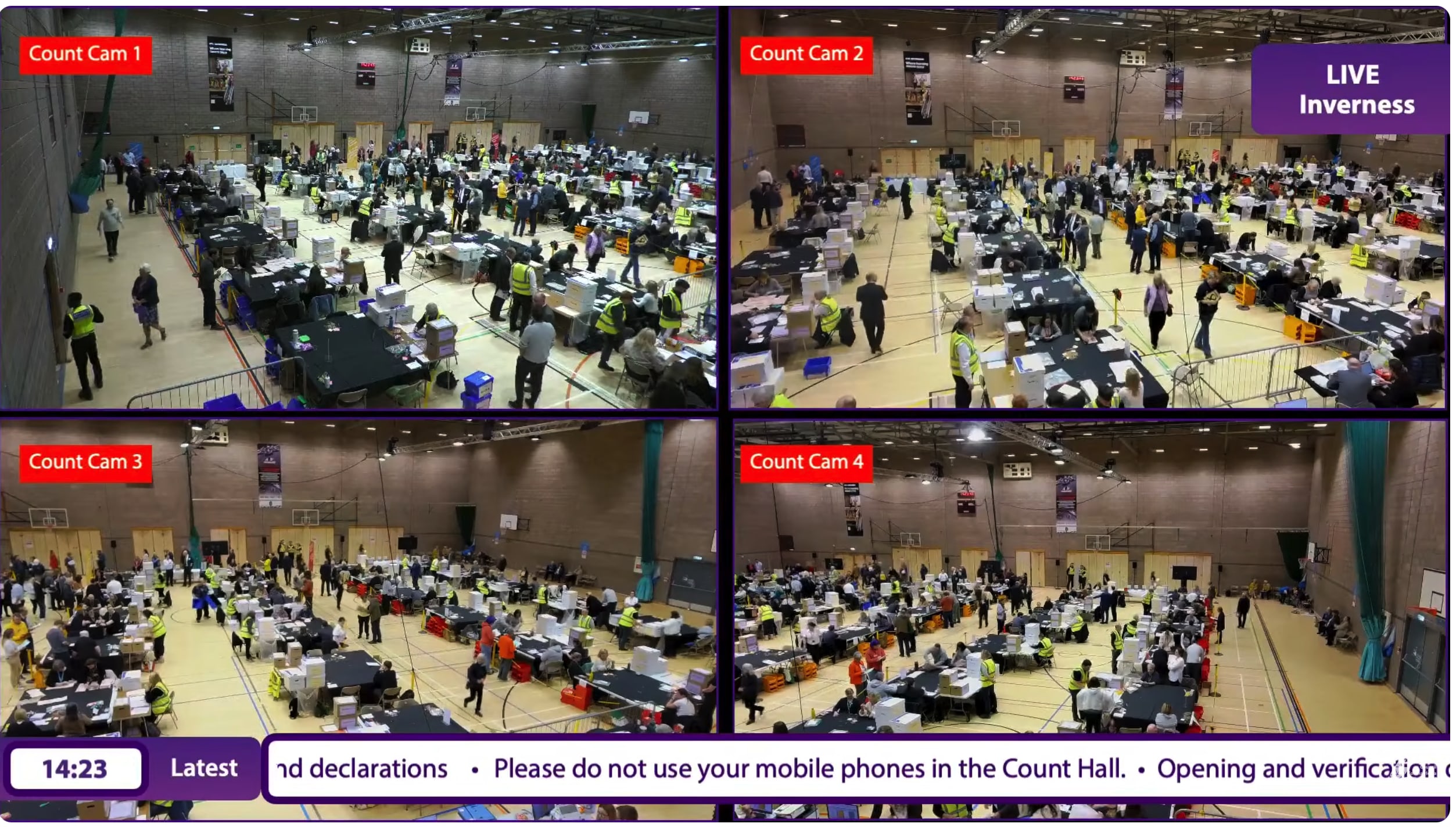
I would have liked to watch this important result on our national broadcaster. It delivered three seats for independence-supporting parties. That tipped the pro-independence majority into the largest the Scottish Parliament has ever had. The SNP and the Scottish Greens together won 57% of all seats.
The Beeb wasn’t expecting that result to take so long, of course – it was scheduled for mid-evening. We joked that the counting was being done on Highland time – but when I said that to a native of these parts, they demurred. Far too fast for that – in living memory, it would have taken a week.
The Press and Journal reported that the delay was due to a couple of very close races in this huge geographic area. They were keen to avoid a recount, which caused a delay at the last general election, so they were being extra careful.
The result tipped into the weekend. But there was nobody chewing over it on Saturday on TV or radio, though there were a couple of podcasts – the first to file was Bernard Ponsonby again, who went through the numbers with columnist Alan Massie on their show The Ponsonby and Massie podcast.
BBC Scotland stuck to its usual Saturday diet of sport and music. In desperation, I turned to Times Radio. Eventually, they addressed the subject of the Scottish election. Presenter Rod Liddle interviewed fellow presenter and host of the Holyrood Sources podcast, Calum MacDonald.
Between discussing what Calum had had for breakfast – haggis, in the pub, apparently – and what he might be presumed to be having for lunch – Scotch pie – Calum spent most of his segment patiently explaining Scotland’s Additional Member voting system as if to an irritable elderly relative at a family lunch.
Obviously, Alastair Campbell wasn’t listening to that, though, because when I turned to his podcast The Rest is Politics, he confidently announced that Scotland and Wales have both introduced new voting systems. Wales did. Not us. No matter – they weren’t much interested in the Scottish election, subsuming it into the general narrative of will Keir Starmer stay or go – which makes no difference here as the attitude of the other candidates to Scotland is the same as far as I am aware.
Had Reform done better, Scotland would have got more attention. Reform did do well in Scotland, ending up equal second with Labour – but they failed to win any constituency seats and their share of the vote was 16%, 40% less than in England, another example of political divergence.
The news line across the UK media from this Holyrood election was The SNP won the election but fell short of a majority. That’s true as far as it goes – which isn’t very far. It is based on ignorance of the Scottish voting system – which means the huge majority of votes the SNP got on the second vote won them just one seat. In Westminster terms, it would be a landslide.
I get it, England has a much bigger population than Scotland. Most of the media we consume is made with a UK audience in mind. Why should they know how we vote or care, for that matter?
But do Fins or Swedes on the day after an important political event tune in to their media services to find the basic elements of their system are misunderstood? At times like this, Scots are very aware that our media sector is a quarter the size of independent countries like Ireland or Denmark. (Read more about that here)
The reality of what happened at Thursday’s Scottish Parliament election has not really sunk in. In 2021, the UK government refused to accept that the Greens were part of an independence super majority because they had not been clear enough about their support for independence.
This time, the Scottish Greens put support for independence at the heart of their campaign. It is hard to argue that this 57% pro-independence majority happened by accident. I am not sure how tenable or democratic it is going to be for a Labour government to ignore it.
Recent polling suggests that support for independence is now above 50%. An average of polls over the last six months is 53% for Yes, if you remove YouGov, which is holding the average at just over 50%, with repeated polls that are several per cent below the others.
Unlike the situation in Northern Ireland, there is currently no constitutional mechanism for Scotland to call another independence referendum. But more Scots are now starting to see devolution as a trap. Too many levers of power are held by an incalcitrant Westminster.
It would be relatively much simpler, for example, for an independent Scotland to take the electricity grid back into public ownership or to innovate in terms of regulation. The weeping sore of Scotland’s outrageous energy poverty rates has to be addressed. Privatisation, which we never voted for, has made our energy network into a means of extracting wealth from Scotland rather than providing affordable power.
Scotland was and is much more strongly pro-EU, and our economy with its much bigger share of food and drink exports and reliance on freedom of movement, has suffered more from Brexit. We have different migration needs – but the UK refuses to acknowledge or facilitate these.
There is a real risk, too, that Nigel Farage will be the next UK PM. I say that as someone who is embarrassed to look back at my 2014 No to independence vote, when I scoffed at suggestions that Boris Johnson would become Prime Minister or that the UK would drag Scotland out of the EU.
A risk mitigation would be to allow Scotland to secure its independence – potentially good news for English people seeking to flee a Reform government.
That Highland result, delivered to the livestream instead of waiting cameras, may prove to be a historic moment – even though it was not televised.