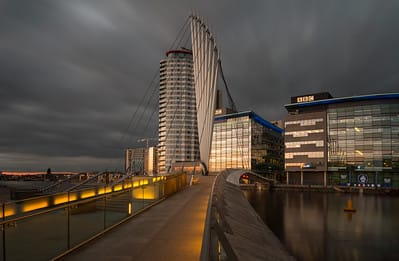
Andy Burnham’s route to power is built on Manchester’s success. It is seen as the UK’s best example of urban regeneration, with shiny new skyscrapers, a tram network and buses in public ownership.
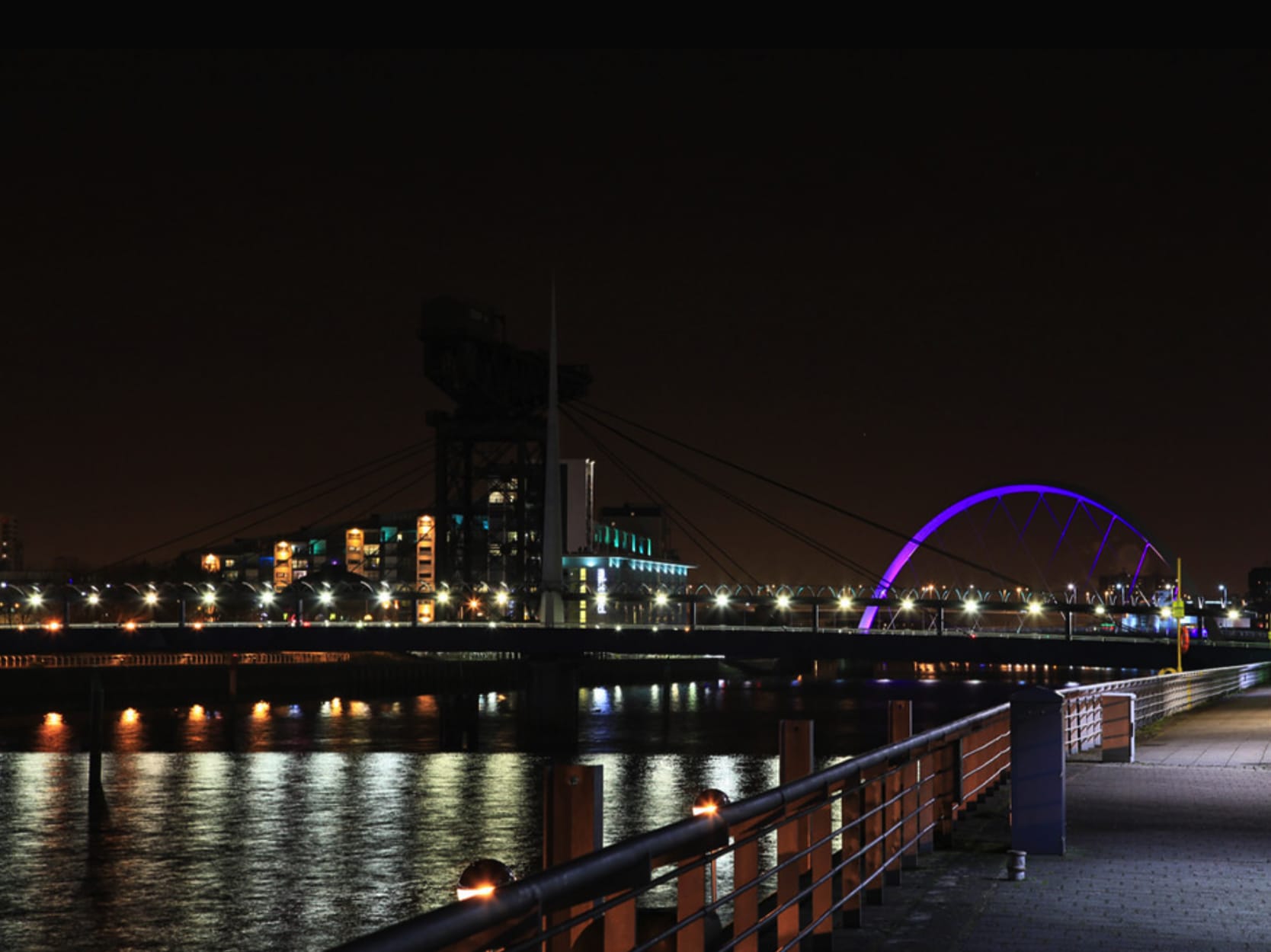
Glasgow has a very different image, as a city still struggling with post-industrial decay. I wrote here about the tragic failure to rebuild the Mack, one of Europe’s most important 20th-century buildings. The recent fire in the Union Corner has left another ruin. And many other iconic Victorian buildings are still decaying across the city. Drug deaths in Glasgow are also three times higher than in Manchester.
Yet, underneath the mainstream narrative, there is a more nuanced picture. For a start, Glasgow does have a lot of successful regeneration projects – the Clyde Waterfront, Finnieston, Buchanan Wharf in Tradeston, Candleriggs. George Square is undergoing restoration. Glasgow has a more intact Victorian city centre so there is more scope for smaller-scale projects to restore what is there rather than replace them with towers.
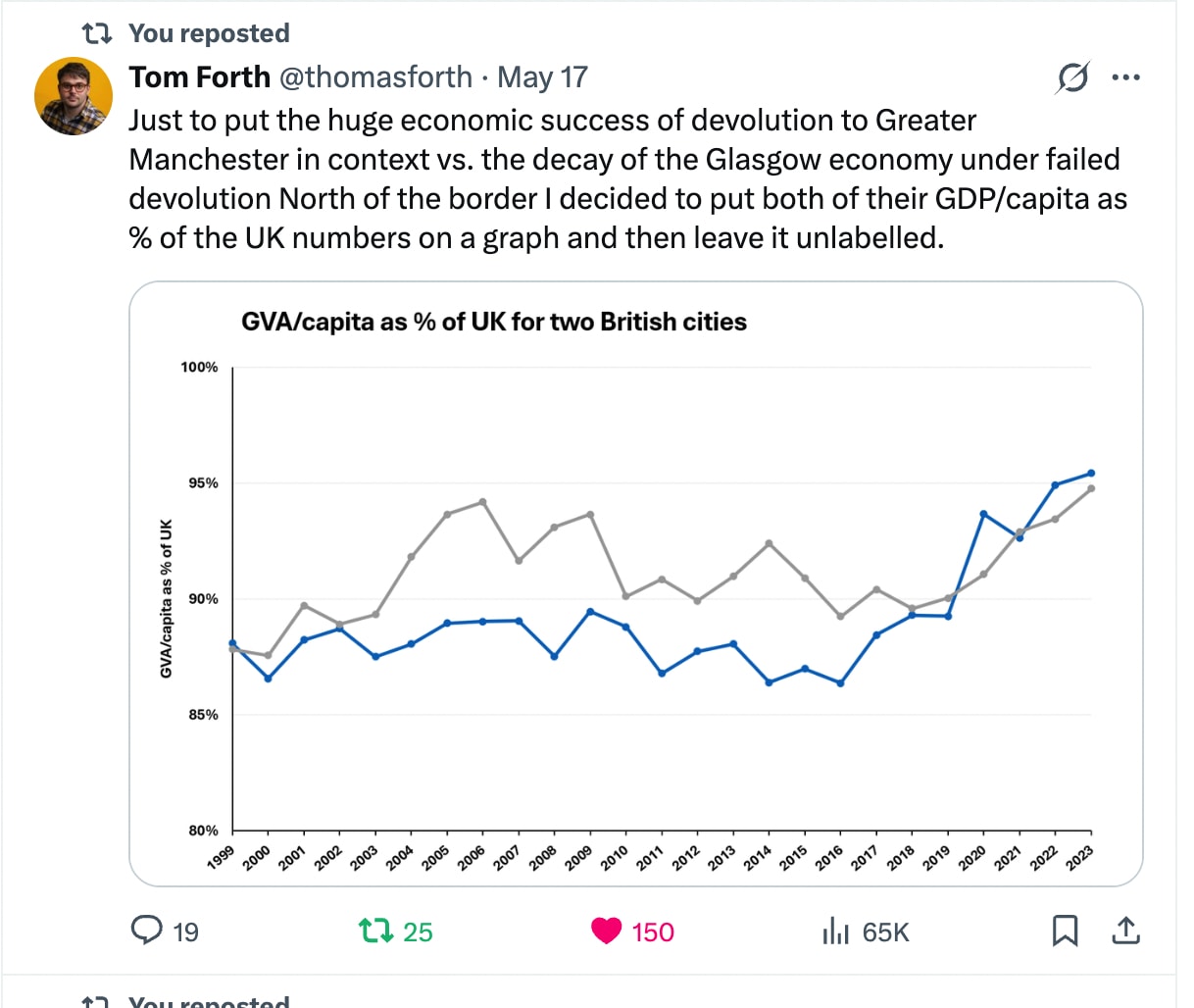
Economically speaking, there is not much in it
Northern English data wonk Tom Forth got a lot of engagement with this post on X. He has refused to label the two lines because the point is that Manchester and Glasgow are doing about the same in economic terms. (I think the blue line is Manchester btw).
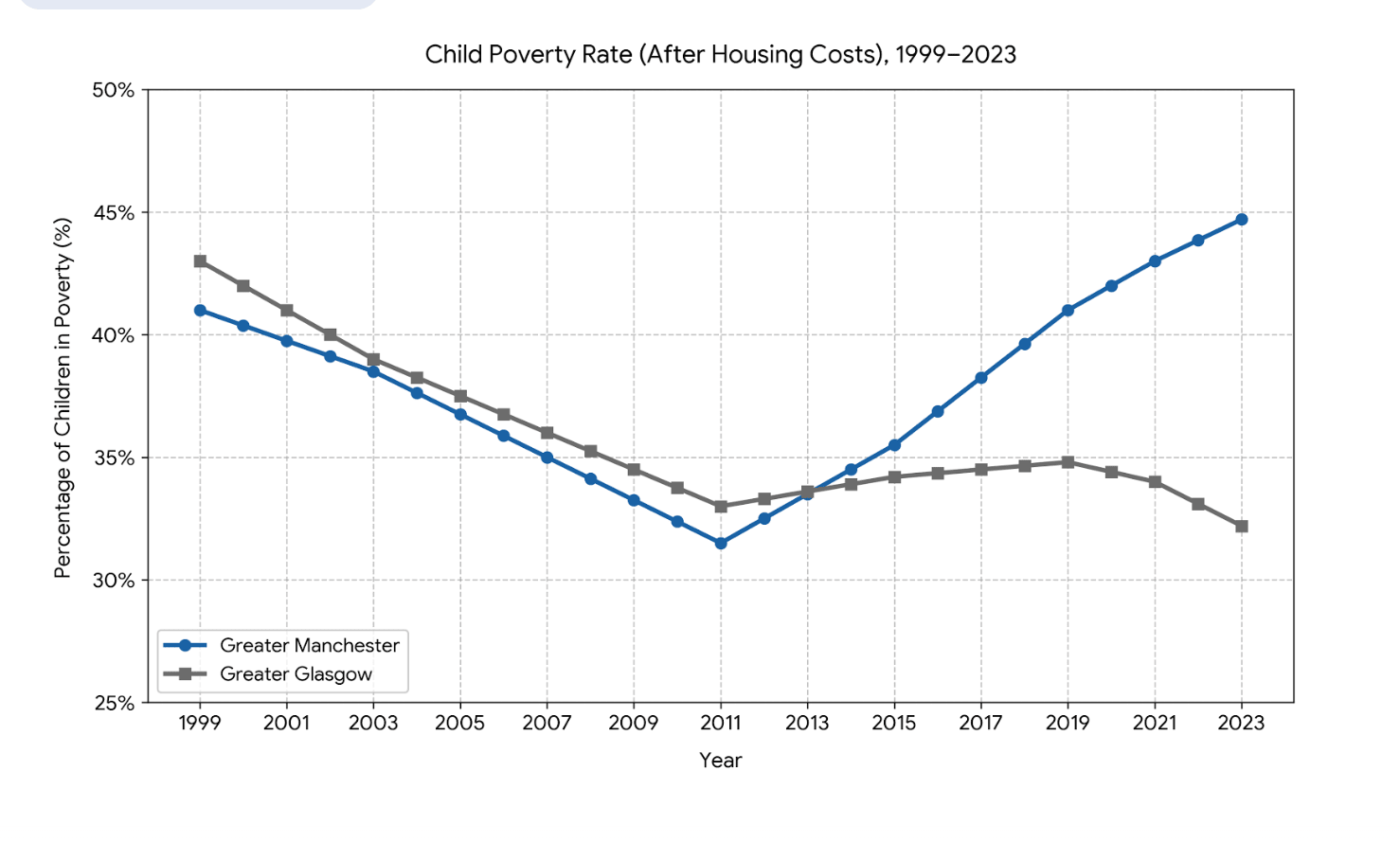
Child poverty, infant mortality and educational achievement are better in Glasgow
There are other areas where Glasgow is doing better. Child poverty in both cities is higher than the UK average – but in Glasgow it is falling, mainly due to the Scottish Child Payment which partly mitigates the effects of the two-child cap.
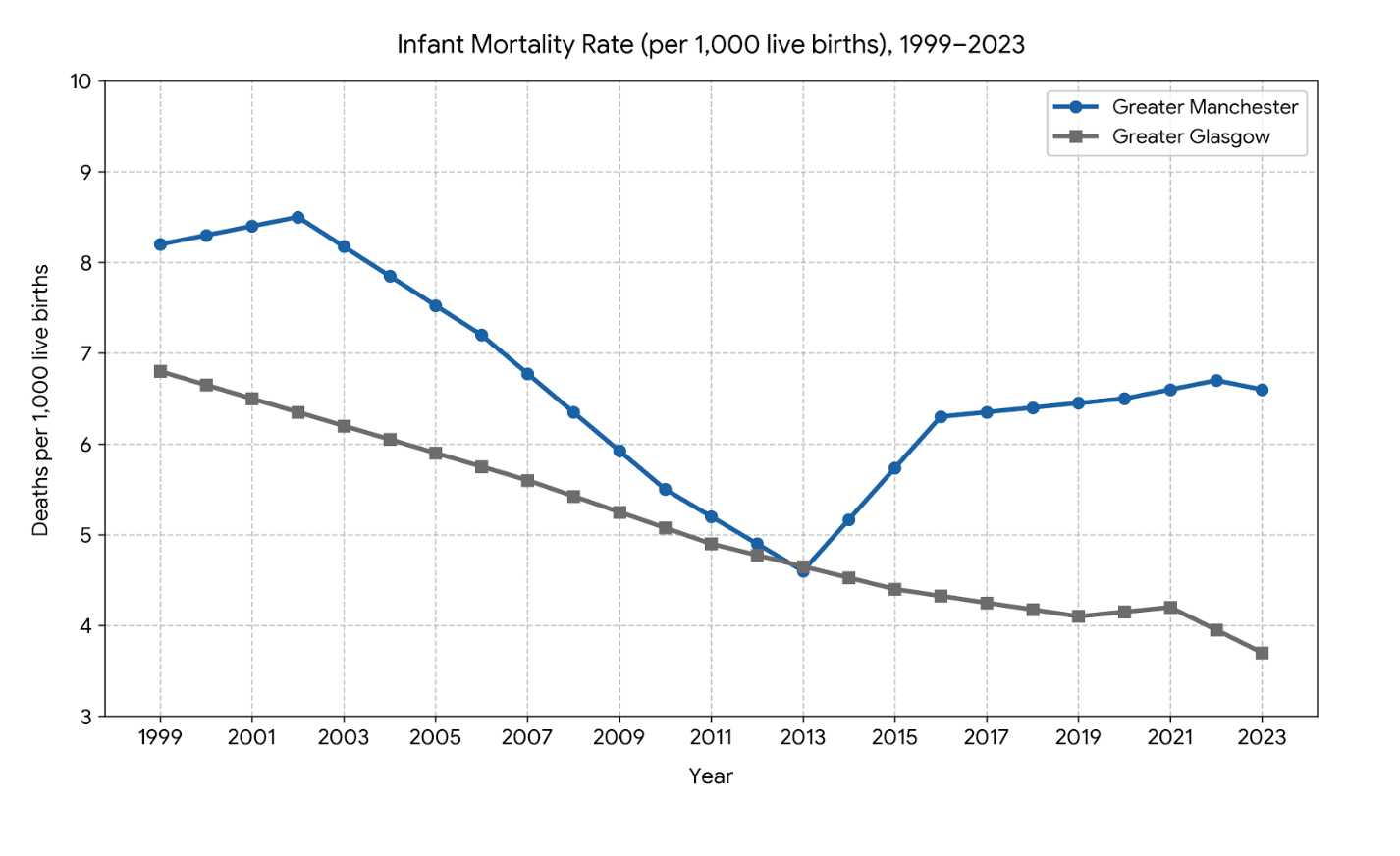
The same is true of infant mortality, which is now half the level in Glasgow compared to what it is in the city of Manchester. There are a range of Scottish Government policies aimed at mother and baby health, like a pre-paid card for Better Start healthy foods, more health visitors doing more visits, and the universal baby box which comes with a safe sleeping mattress.
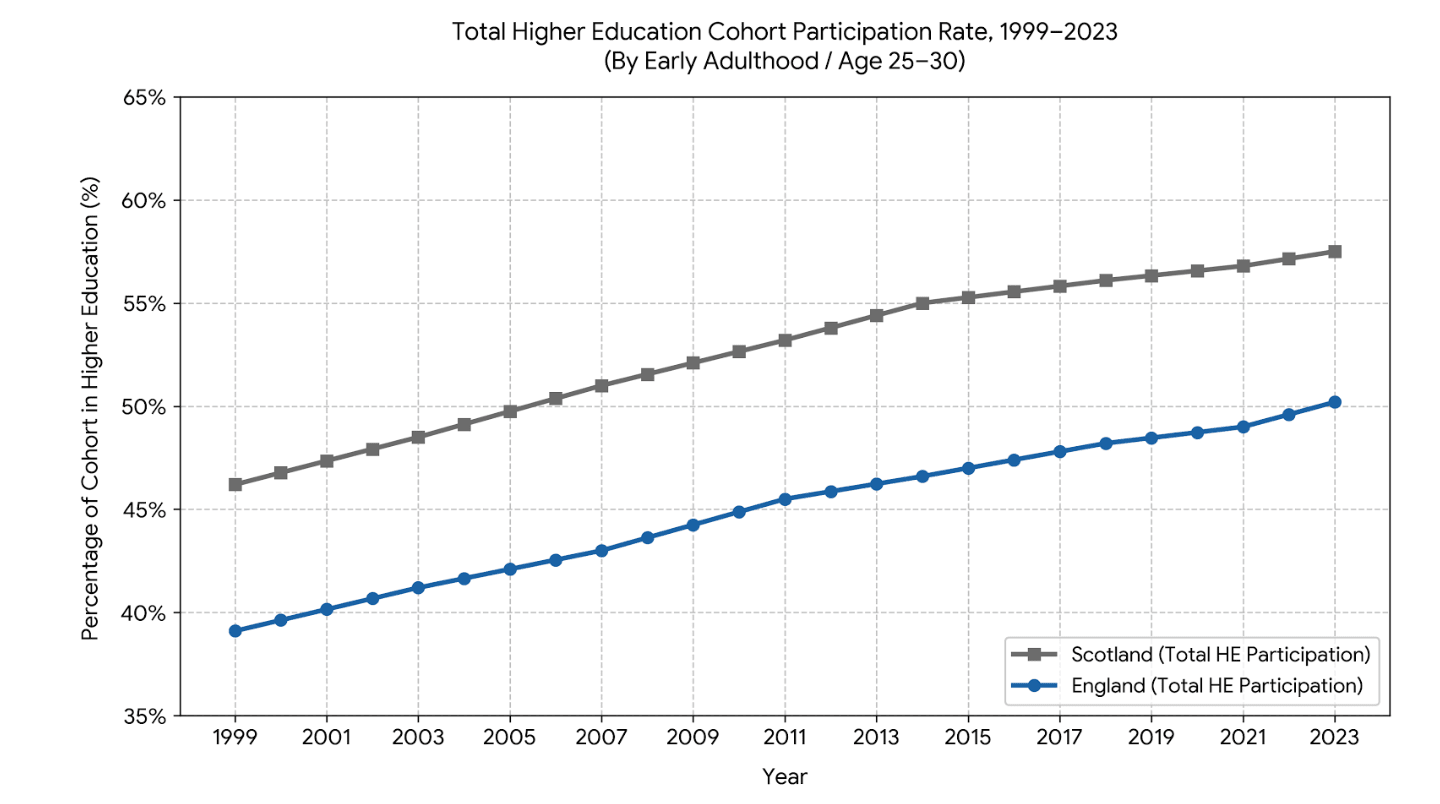
Glaswegian youngsters are also significantly more likely to achieve higher educational qualifications than those in Manchester. In his book Head North, Burnham calls for a rethink of higher education, with more emphasis on vocational qualifications. Perhaps he could look at Scotland.
Many Scots go from school at age 16 or 17 into colleges where they sit HNC or HND qualifications. If they want to continue studying, they can transfer into the second or third year of a University course. This flexibility and the on and off-ramps are a reason that Scots are more likely to progress into higher education. The fact that they don’t have to pay university tuition fees is another factor.
Manchester has caught up on affordable housing
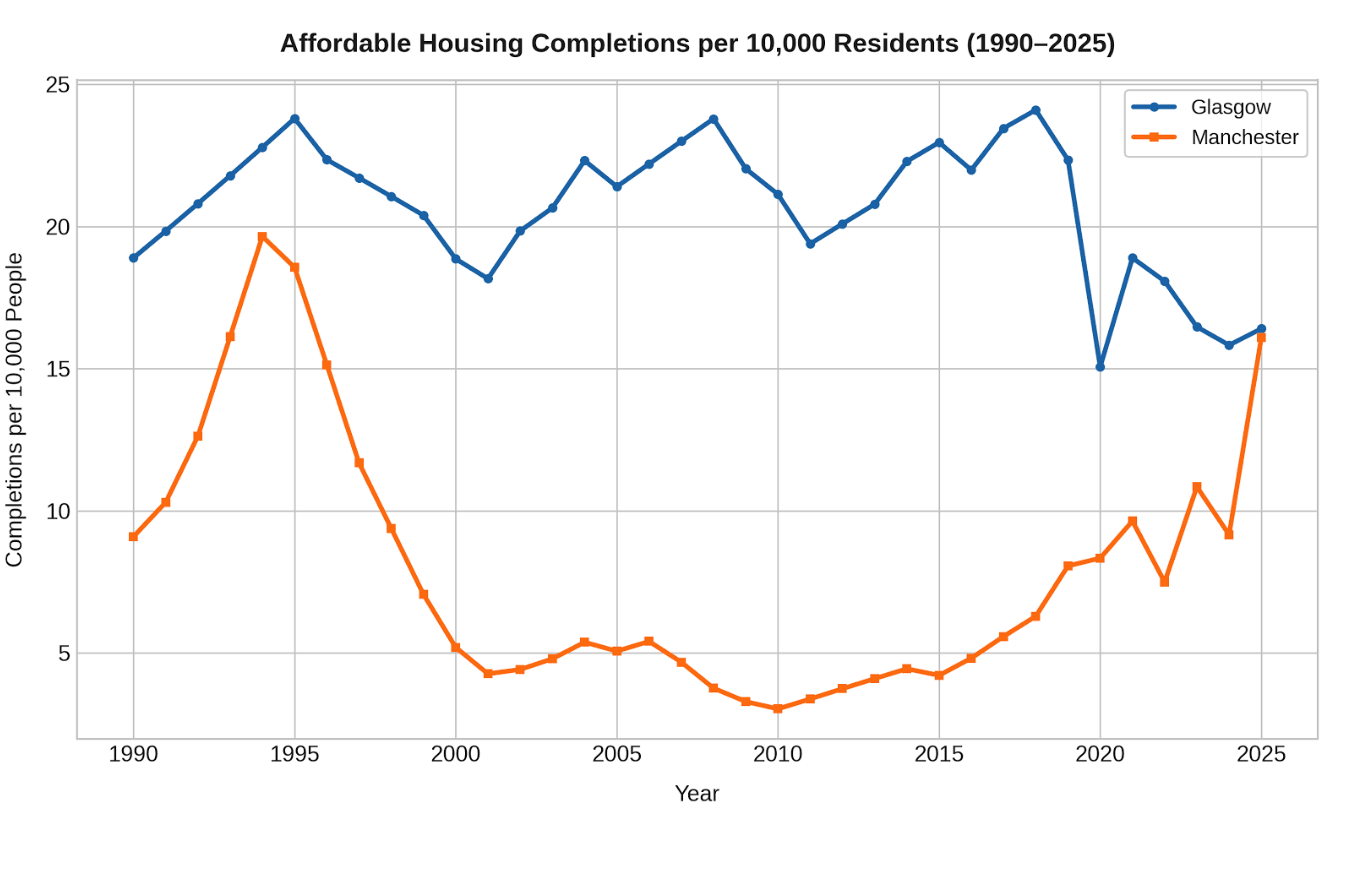
Glasgow has been building more affordable housing per head than Manchester for decades – until last year, when Manchester caught up. Both cities have similar high levels of homelessness, but it is hard to compare them directly because they are counted differently.
Greater Manchester is a big region and tax base
Andy Burnham is the Mayor of the Greater Manchester Combined Authority (GMCA). The city centre of Manchester has about 550,000 people. But the authority incorporates 10 completely distinct metropolitan boroughs under one giant administrative umbrella. This creates a unified region of 2.8 million people.
It means the wealth generated in the affluent commuter belts of Trafford and Stockport is structurally captured and pooled alongside the deep post-industrial deprivation of Oldham and Rochdale. Burnham can plan transport (The Bee Network), housing, and policing across the entire economic footprint of the region.
Strathclyde Regional Council was a political and economic powerhouse
Glasgow was once part of the Strathclyde Regional Council, created in 1975, which ,was the most powerful local government body in Europe. It didn’t just cover Glasgow’s commuter belt; it covered nearly half the entire population of Scotland (roughly 2.5 million people). It stretched from the tip of Argyll and Bute all the way down to the depths of Ayrshire.
Strathclyde operated like a state government inside Scotland. It controlled the police, fire services, water, major transport, and education across a massive chunk of the country.
Strathclyde is the main reason Scottish Water remains in public hands. Strathclyde Regional Authority held an advisory referendum to test the strength of feeling about water privatisation in 1994. They held a postal ballot. There was a huge turnout and 97.2 per cent wanted Scottish water to remain in public hands.
Soon after that, the Conservative Government in Westminster decided to abolish Strathclyde, which was a power base they did not control. They had abolished the Greater London Council the GLC for similar reasons a decade earlier.
Glasgow is like the middle of a big doughnut – all the sugar is on the ring
The Tory Secretary of State for Scotland at the time, Ian Lang, explicitly admitted later that the goal was to break up the “baleful shadow of socialism” across the central belt. The Tories knew they could never win elections in a giant, unified, Labour-dominated Strathclyde. So, they used the Local Government etc. (Scotland) Act 1994 to break it into 12 unitary authorities.
When they drew the new lines for Glasgow City Council, they deliberately gerrymandered the boundaries to isolate the city’s finances:
Glasgow now suffers from the “doughnut effect.” * Glasgow City Council now contains around 630,000 people. It holds a massive concentration of Scotland’s deep multi-generational poverty, crumbling Victorian infrastructure, and massive social costs.
The wealthy commuter suburbs – where the people who use Glasgow’s roads, parks, and cultural venues live – are entirely separate local authorities.
There is a Glasgow City Region cabinet (established for Westminster City Deals), which brings together eight local councils (including Lanarkshire, Renfrewshire, and Dunbartonshire) to mimic Manchester’s 1.8 million regional population. But it has no elected Metro Mayor and no centralised tax-pooling power. It is just a committee of council leaders. Glasgow City Council has to fund the heavy lifting of the city on its own shrunken tax base.
So when, for example, the opportunity presents to do something major about the M8 to heal the scar it has created through the city, or rebuild the Mack, it struggles to have the financial capacity.
Each can learn from the other
In Head North, Burnham criticises the Scottish Government for being overly centralised and failing to devolve power to cities and regions within Scotland. It is a fair criticism.
Arguably, in the areas where Glasgow is doing better than Manchester, its citizens are benefiting from Scottish government policies aimed at reducing poverty and inequality across the country. If Burnham becomes the next Prime Minister of a UK Labour government, perhaps he can look at copying some of those.
We can all learn from what others have tried and tested.