
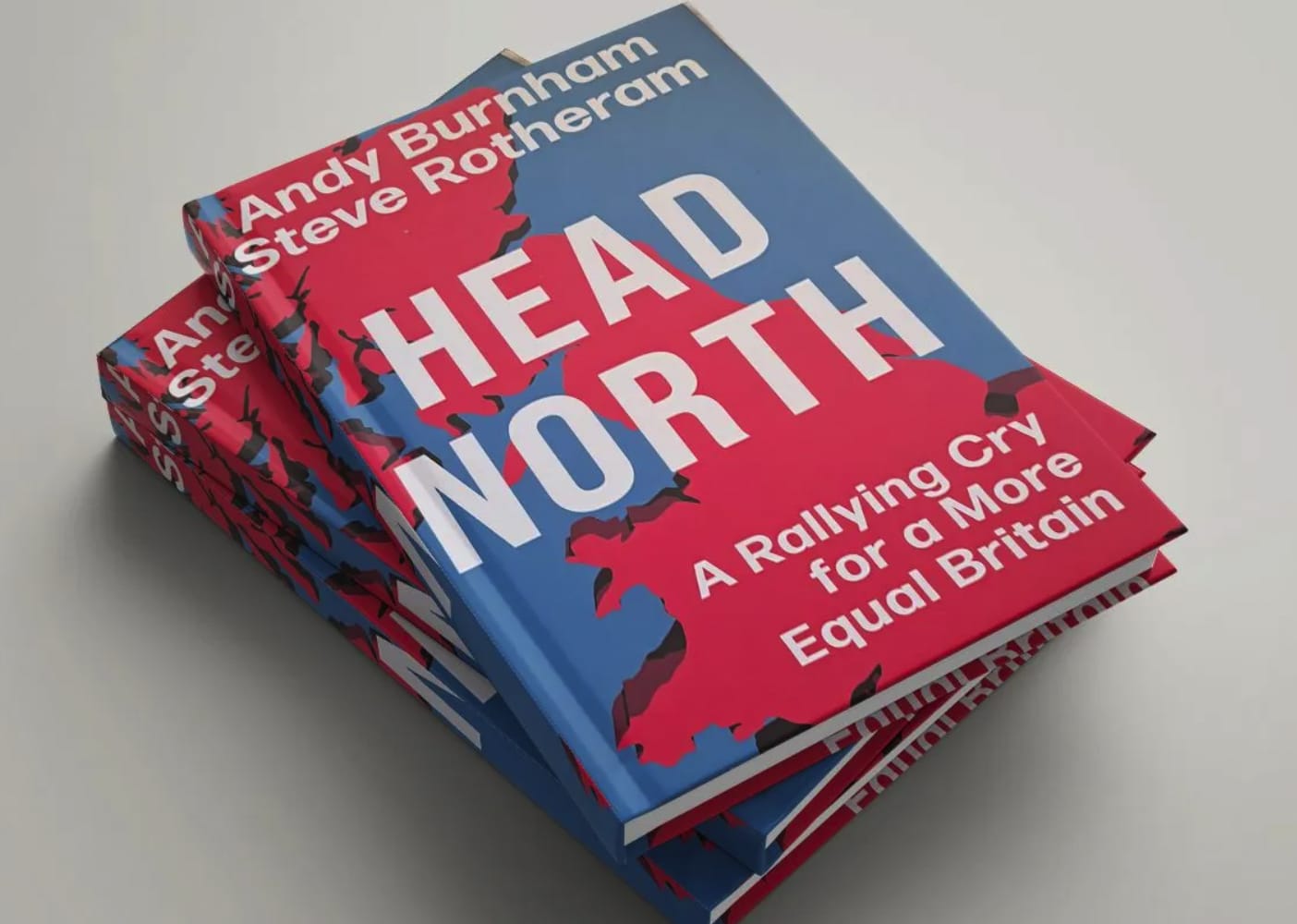
I have been enjoying catching up with Andy Burnham’s book Head North this week, which he wrote with Liverpool mayor Steve Rotherham, and which they read themselves on the audio version. There are quite a few laughs along the way.
The book is two parts (like my response to it – I published another post yesterday). The first half is a personal account of their political careers – they connected over trying to get justice for the victims of the Hillsborough football disaster. Rotherham was at the game and swapped his ticket with another fan just before kick-off – his original ticket was for the Leppings Lane end, where the tragedy unfolded. He writes that he now knows the meaning of survivor’s guilt.
The duo argue convincingly that the disgraceful cover-up of this disaster came out of an existing imbalance. For too long, the North of England has been treated as lesser by a system that sucked money and power into the South East.
In the second half of the book, they lay out a prospectus for reengineering the British state to make it less centralised. From a federal structure to electoral reform and abolition of the House of Lords, there is a lot there that Scots can get behind. (The Keir Starmer alternative of sticking with the status quo just won’t cut it. Read about how Starmer’s reset speech sounded to Scottish ears here).
On your marks, England!
All of the Celtic nations now have pro-independence First Ministers. Surely this is a moment to grasp the nettle and make real changes to the status quo – in part to get England ready for the possibility of self-government.
In an interview in the New Statesman (May 16), entitled Anthony Barnett: England, ethno-nationalism and what I told Andy Burnham, author of the Break Up of Britain, Anthony Barnett, argues that Burnham is right in arguing now is the time for radical change.
“There are two acceptable democratic options in the long run. One is a federal Britain, where the Scots and the Welsh – Northern Ireland is different because its status is already agreed by international treaty – and the English concur on a shared constitution, in which the membership is freely made and can be freely undone, a proper federal relationship. And we all join the EU as Britain.
“The second is that Scotland and Wales become independent, and we all rejoin the European Union independently…What would be intolerable is for Britain to become a prison of nations policed by England.”
Part of Barnett’s prospectus is that the left should reclaim the flag of St George and the idea of Englishness. He rejects any ethnic component, quoting Daniel Defoe
From The True-Born Englishman
By Daniel Defoe
A true born Englishman’s a contradiction,
In speech an irony, in fact a fiction.
A banter made to be a test of fools,
Which those that use it justly ridicules…

How shall we else the want of birth and blood supply?
Since scarce one family is left alive,
Which does not from some foreigner derive.
In Head North, when Brunham quotes from his big anti-Brexit speech to the north of England, it includes the line “I am British before I am English”. In it, he equates being “English” with a more narrow nationalism and being British with an international, pro-EU outlook. But in fact, he very much situates himself within England – as the title of his book and his nickname “King of the North” demonstrate.
Barnett links the history of “Britishness” to imperialism. (Arguably, the current centralised British state emerged out of a reaction to the end of Empire – with a London elite desperate to maintain its position). Barnett wants to see English moderates be English first and British second.
Englishness has a long tradition of radical thinking, respect for liberty and human rights, love of nature – from the Magna Carta to David Attenborough via Thomas Paine, Mary Wollstonecraft, Robert Blatchford, Harriet Martineau, Edward Rushton etc etc. It is time to rediscover pride in Englishness’s best traditions and stop allowing it to be defined by Nigel Farage and his ilk.
“But we need your seats, Scotland”
When I speak to English friends about Scottish independence, the main reason they say they object to it is that “Scottish seats at Westminster help Labour to gain power” and they also hope Scottish votes will put a brake on Reform. Guys, that is not a good enough reason.
It is true that Labour has historically depended on Scottish seats at Westminster – though we now have 57 MPs down from 72. But only once in recent years have Scottish seats made a difference to the result – the 2010 election would have been a victory for the Conservatives instead of a coalition with the Lib Dems without Scottish votes.
Burnham and Rotherham argue that Westminster should introduce an electoral system like the one we use in Scotland. It is a blend of First-Past-the-Post and Proportional Representation. With 38% of the vote, the SNP under John Swinney have emerged a clear winner, though without an overall majority. Meanwhile, in Westminster, under FPTP the Labour Party got a landslide with 33%. (Some argue that the Scottish system is not proportional enough – but I don’t think UK politics is ready for a system with no clear winner. )
If England does not change the voting system, then, as an independent or self-governing country, it is probably looking at permanent right-wing government.
The “reformed” House of Lords is worse than before
Equally, the so-called reform that Labour has applied to the House of Lords has only increased its London-centricity. Getting rid of the hereditary peers has made the House LESS representative of the nations and regions and more of the inside of the M25.
Now we have members who are appointed basically because they attend the same London dinner parties as the politicians of the day. They are appointed for services rendered – in many cases, we the public, do not get told what services. ( eg scion of a Russian oligarch Evgeny Lebedev was given a peerage – he also has a pet wolf named Boris. We don’t get to ask why.)
Rotherham writes: “There are few more powerful symbols of need for House of Lords reform than the sight of David Cameron waltzing up Downing Street in November 2023, ready to take up the position of Foreign Secretary”.
We have yet to see if Burnham is successful in beating off the challenge of Reform. Their rise also comes out of a wider rejection of the current status quo across the UK – another symptom of cracks in the system.
The Union can’t continue as a prison of nations
If the Union is to survive, it cannot be simply as a mechanism for concentrating power in London. It will have to become a genuinely voluntary partnership of nations, built on democratic reform, decentralisation and teamwork based on mutual respect.
And if that proves impossible, then the English people too will eventually have to decide what kind of country they want to live in. Barnett is right that there is a progressive, radical tradition within Englishness that deserves to be reclaimed from the populist right. The flag of St George should not be the exclusive property of Nigel Farage and Tommy Robinson any more than patriotism is solely the preserve of nationalists.