First, an appeal – I am fundraising here to help our friend, Tanzanian environmental activist Mathias Lyamunda, to speak up for his country at the international Zero Waste Forum 2026 in Istanbul. A lot of the waste we think we recycle actually gets shipped to Africa.
Last week I caught up with an old friend, Mike Magee, who is back in the UK for a short time. Mike is the VP of the International Harbourmasters Association. He is also the group H Harbour Master of RAK Ports in the United Arab Emirates and was formerly the Harbour Master in Leith.
We talked about the plight of the many seafarers, believed to be around 20,000, trapped in the Arabian (Persian) Gulf by the closure of the Strait of Hormuz. Mike, who began his career as a merchant seaman, is very aware of how difficult life is for them and how little attention is paid to them by the world’s media.
JACKIE: I am transcribing this interview, and I notice my transcription service is writing ‘sea fairies’ instead of seafarers. In a way that encapsulates how we see them – as in we don’t see them, they just invisibly bring our stuff. Do you think most of us just rarely give them a thought?
MIKE: Yes, it is sometimes called “the invisible industry”. When you buy things that come from other parts of the world, you probably don’t think about the people who brought it across the sea – 80 to 90% of the world’s goods are transported in ships.
Seafarers often come from low-income countries like the Philippines and Myanmar, but to be fair, they usually see themselves as the lucky ones. They do perhaps nine-month contracts on ships. They spend a lot of time away from their families, but what they get paid is probably not huge wages, but a lot more than what the average is for the people in those countries, so they’re prepared to do it.
JACKIE: Can you tell me a bit about the issues that they are facing at the moment?
MIKE: Most of the ships in the Gulf are static; they can’t go anywhere. The seafarers are trapped. The crews on board are having to face issues of overhead explosions, and never knowing when they may become a target themselves. They have also faced VHF harassment.
JACKIE: That is a new one to me – what is VHF harassment?
MIKE: All ships have VHF radios, and ports have VHF radios. So, when a ship wants to speak to another ship, there’s a channel called Channel 16, which is a VHF channel that all ships listen to. Transmissions have been made recently purporting to be from the Iranians on channel 16, threatening ships in certain areas in the Gulf. This causes anxiety and fear amongst the crew, especially when the name of the ship is used.
JACKIE: It has been months since this started. Are the crews getting changed over?
MIKE: Some of the crews are getting changed over, some are not. It depends on the owners. It is also difficult for the shipping owners – they are losing money and some of them are at risk of going bankrupt. So it is a complex situation.
JACKIE: If the ships are not going anywhere, why do they need crews? Can the seafarers not get evacuated?
MIKE: No. If a ship is anchored at sea, and the anchor breaks, or the chain breaks then that ship will be adrift. It is then a collision risk and is likely to end up on a shoreline somewhere or block a channel at a port. This is both dangerous and a significant environmental risk as ships have fuel on board and in the case of a tanker, a liquid cargo. It is the same for all ships – they can’t be left without a crew at sea..
JACKIE: Yes, I read that a salvage crew that was going out to the Safeen Prestige (which was a container ship, which had been previously hit and had gone on fire and been evacuated) came under attack. The tugboat that was assisting took a direct hit and sank – four people were killed and three critically injured. I think that is the biggest loss of life in the conflict so far, when it comes to seafarers, but there have been multiple other attacks and many seafarers killed and injured.
MIKE: Yes. That incident really brought home how dangerous the situation is. Everyone was shocked when the tugboat was attacked.
JACKIE: I have read that the stranded crews are at risk of running out of food and water – is that happening?
MIKE: Not as far as I am aware. Many of the ships have either come into the harbours along the coast or they are anchored outside the harbours or close to the coast. There are obviously too many ships out there to bring them all into ports, but if a ship wants to come into a port, to offload garbage, load fuel, change crew, take provisions, yes, they can do that if they wish, or they can anchor and be serviced by the port boats coming out, taking out the supplies that they need.
JACKIE: Their families must be very worried about them. It is good to hear that they are not starving. I actually hadn’t thought about the garbage – that must be a problem. It is hot, right, so you don’t want garbage piling up?
MIKE: Yes, it is very hot there now, and garbage is a problem. In fact, it’s something that we’re looking at to see if we can provide a service to pick it up. It’s complicated for us, because that garbage then has to be processed on land. We have to set up separate skips for say food waste and packaging, and then others for hazardous waste like the paint they use to paint the ships. The ships within our port limits – we’ve got a duty to care for them, because they’re within our port limits, but the ships that are out at sea are more difficult to deal with.
JACKIE: Do they dump their garbage in the sea?
MIKE: Seafarers don’t tend to do that – they have an affinity with the sea. In addition, the Gulf is a special protection area and has strict environmental regulations. It is particularly sensitive as it is an enclosed sea, with flow only via Hormuz. The Gulf is believed to completely replenish its water once every three to five years. We would see it if that was happening.
JACKIE: What about their toilet waste?
MIKE: Ships have onboard sewage treatment plants that handle human waste. Once it is treated, they can discharge it overboard.
JACKIE: Does it have nutrients in it? Is that part of the issue with the way that barnacles and jellyfish are clustering around the ships, which I read about in the Financial Times last week?
MIKE: To be honest, I don’t know. It is possible.
JACKIE: I know you went out to visit the crew of two stranded ships last week. What was that like?
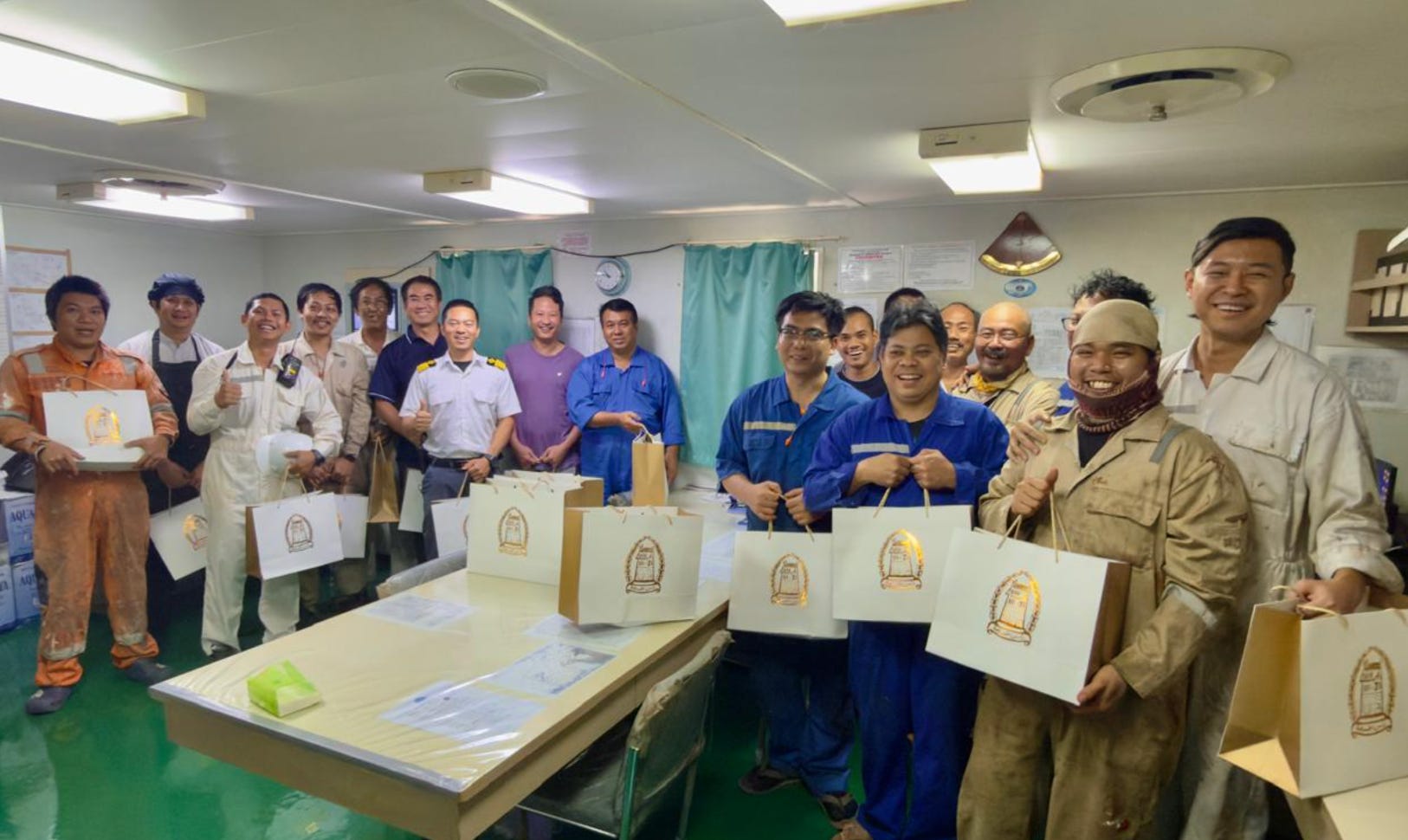
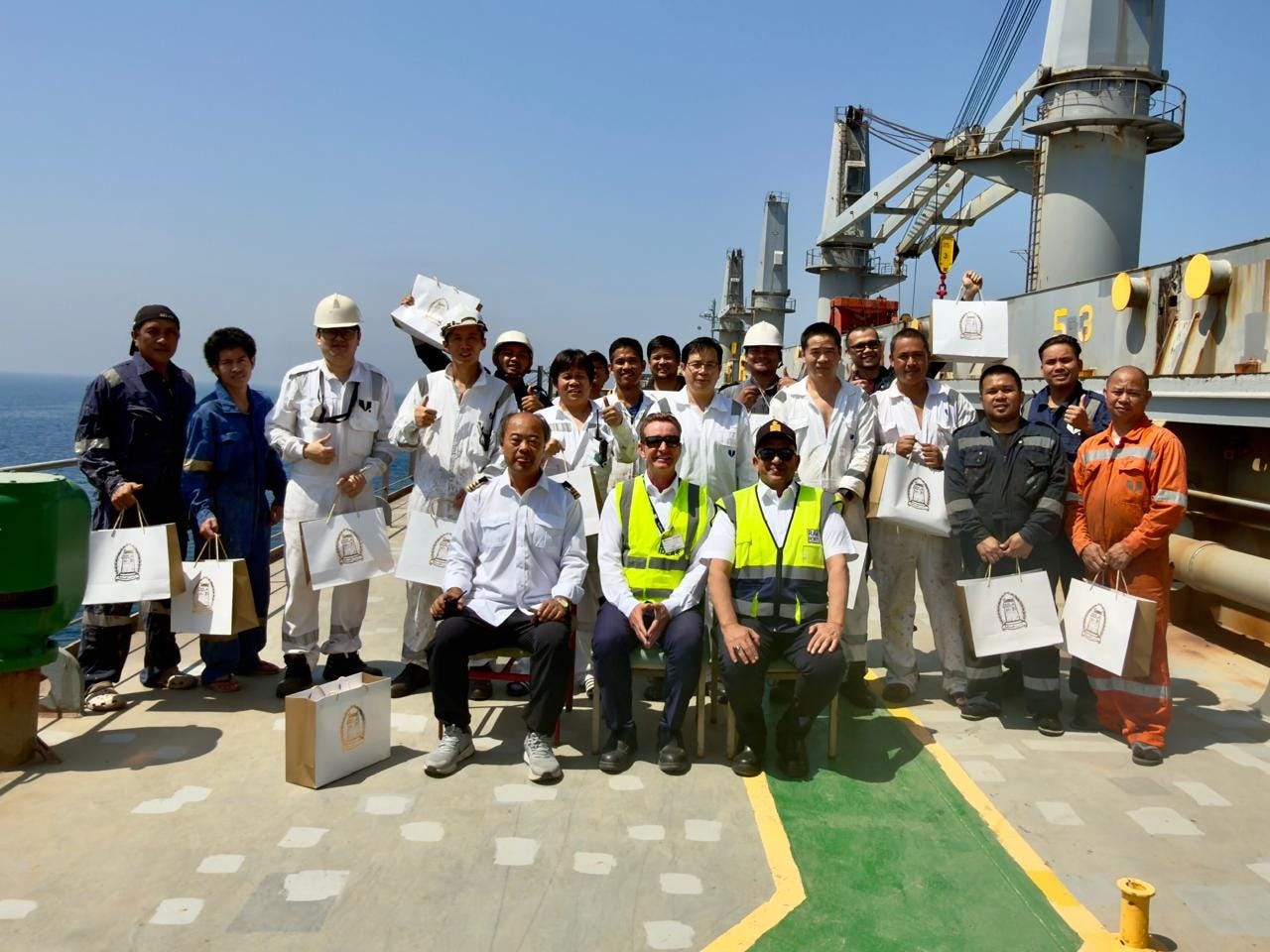
MIKE: Yes, I went on board two anchored ships trapped since day one of the conflict. I mentioned to Sheikh Saud (Sheikh Saud bin Saqr Al Qasimi is the ruler of RAK) that I was going. He insisted I take the crew of each ship (40 in total) a gift of dates and honey from his farm. The crew were so grateful for our visit – I was with my Deputy Capt Emad. It was quite moving. We organised to remove all their garbage and gave them details of how they could go about a crew change, and offered any support we could give them. The Chinese captain of one of the ships was organising a daily meeting for the crew to share their thoughts and feelings about their situation, and they are supporting each other through it all.