
If you strolled up to Checkpoint Charlie in Berlin and encountered an information board that asked you to “Imagine what it would have been like to be a member of the Stasi” you might be a bit taken aback. You might be equally surprised to read a whimsical poem about how boring life was for the poor old border guards, on their feet for hours with nothing to do except shoot at the occasional defector fleeing across the notorious Death Strip. Yet if the place was run by the National Museum of Scotland or Historic Environment Scotland, that is pretty much exactly what you could expect.
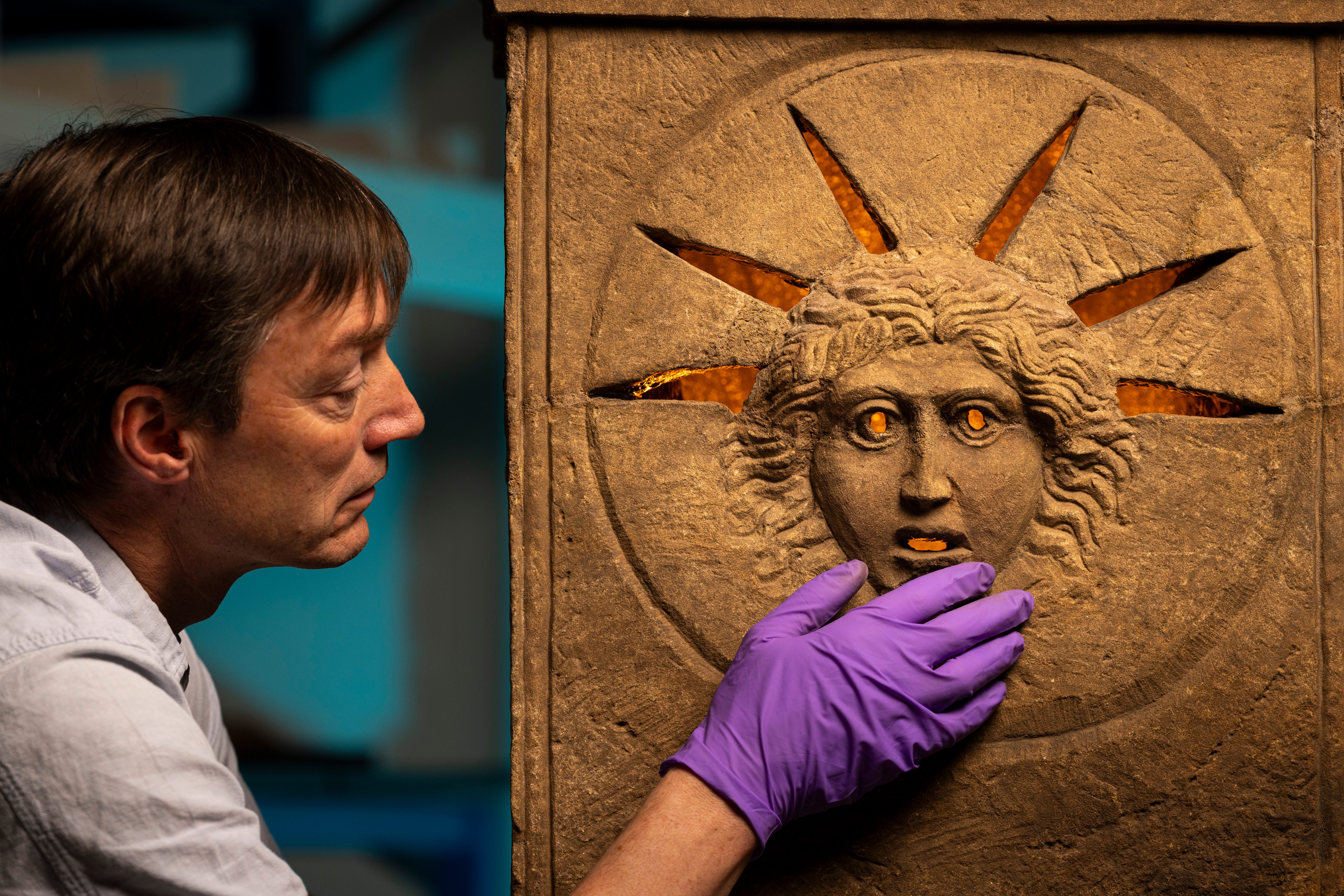
I got an email the other day from the NMS advertising a new exhibition opening this autumn entitled Roman Scotland: Life on the Edge of Empire, which promises to uncover what life was like for the soldiers who were part of this massive war machine.
HES takes a similar approach. I went to look at the Antonine Wall, the wall the Romans built between the Forth and Clyde estuaries, with friends who were visiting Scotland from the USA. We looped a loop of brown signs that seemed to peter out, before eventually locating the approximate area. After parking on the edge of a bus stop, we plunged on foot into some woodlands, skirting an encampment of hoodie-clad teenagers seated round a roaring bonfire (so great to see them off social media), before eventually locating “Checkpoint Caledonia”.
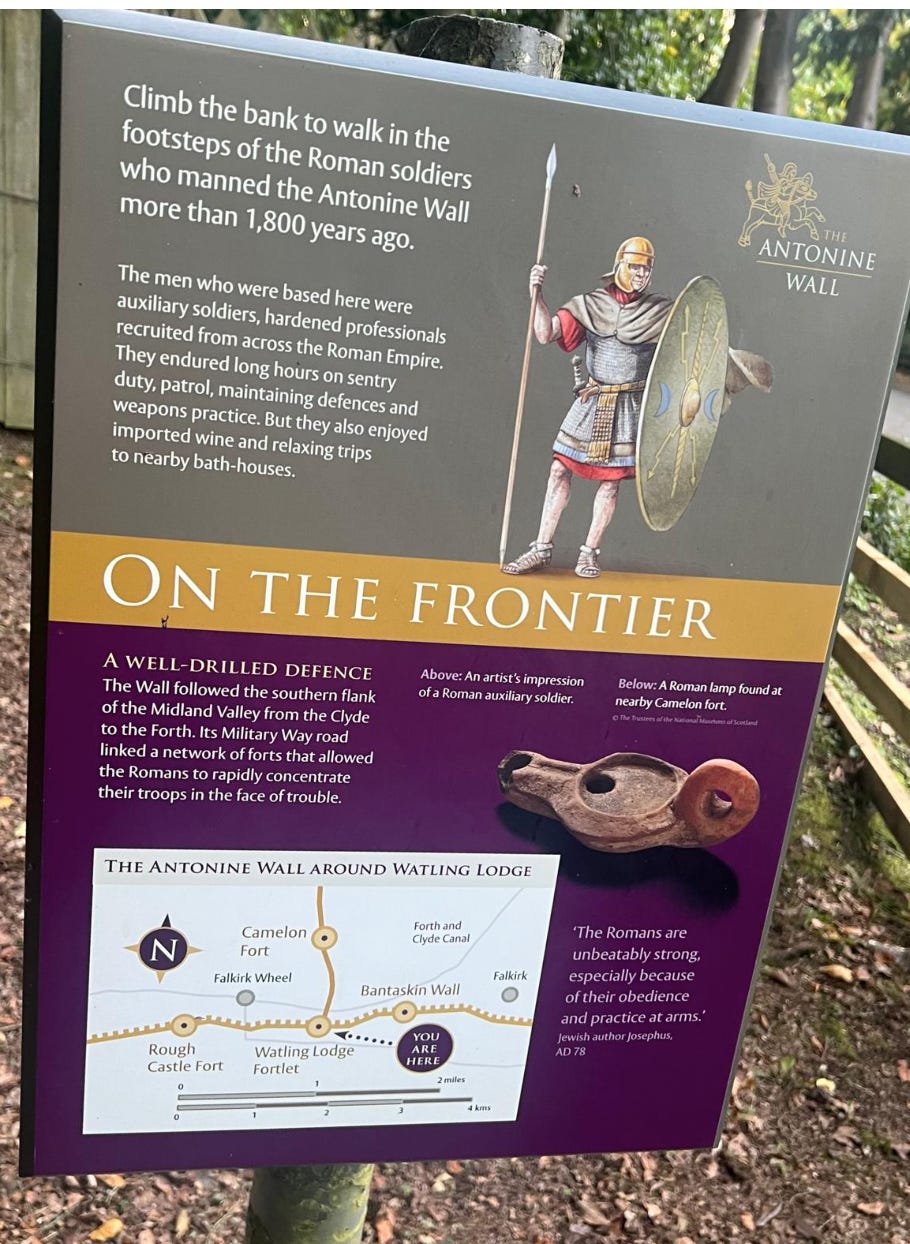
The sign reads:
Climb the bank to walk in the footsteps of the Roman soldiers who manned the Antonine Wall more than 1,800 years ago.
The men who were based here were auxiliary soldiers, hardened professionals recruited from across the Roman Empire. They endured long hours on sentry duty, patrol, maintaining defences and weapons practice. But they also enjoyed imported wine and relaxing trips to nearby bath-houses.
“The Romans are unbeatably strong, especially because of their obedience and practice at arms.”
Jewish author Josephus, AD 78
Some visitors cast a sceptical eye over the pro-Roman perspective displayed here. The project “Rediscovering the Antonine Wall”, calls it “the biggest most awe-inspiring project the people of Scotland had ever seen. Dr John Reid comments acerbically in his book “The Eagle and the Bear” that “this is unlikely to have been among the first reactions of the people this leviathan sliced in half”.
At another point, the Antonine Wall signage even quotes from WH Auden’s poem Roman Wall Blues: “Over the heather the wet wind blows/ I’ve lice in my tunic and a cold in my nose.”
The view expressed on the HES sign that the Romans were invincible is questioned by Reid who argues that the Legio IX Hispana the Ninth Legion were routed by a massive Celtic rebellion. The last explicit mention of the Ninth in Britain is inscribed in AD 108. By AD 165, they vanish entirely from the imperial military rolls.
If the disappearance of the Ninth Legion were treated like a modern murder investigation, Reid argues, detectives would start with two questions:
-
Where was the deceased last seen alive?
-
Who was their last known contact?
For centuries, the widely accepted view was that the Ninth was wiped out in Scotland by the local Caledonian tribes. However, modern revisionist historians prefer to argue that the regiment simply slipped away to Europe and was defeated elsewhere. To many writers, this desperate attempt to argue that the Ninth could not possibly have been bested by the “barbarian” Celts reveals a persistent cognitive bias.
Because the Romans wrote things down and the Celts didn’t, the Roman record is the main source. But they didn’t write everything down, and what did survive is fragmentary. For example, there is only one surviving written record of Emperor Hadrian slaughtering 500,000 Jews to crush an uprising. If that single text had been lost to time, we would be left guessing.
The physical evidence in Scotland tells its own story. Archaeologists have found a widespread distribution of essential Roman military kit – in particular metal mess tins – scattered across Lowland Scotland. This was a key piece of a soldier’s equipment, and it is unlikely that they would have sold them. Revisionists cite them as evidence of trade but Reid demurs.
“These items, spread over a wide area of Lowland Scotland, would indicate a very atypical pattern of ‘trade’ which just happened to take place at the same time as the IXth reputedly departed for the Continent, with no record of ever having reached its destination.”
The far more likely scenario is that the Ninth Legion met a violent end at the hands of a population fighting for survival against a mighty imperial war machine. The tribes would have learned new tactics from their defeat and massacre at the battle of Mons Graupius in 83 AD. The Roman writer Tacitus put a famous speech in the mouth of the Celtic leader Calgacus on the eve of that battle (how could Tacitus have known what was said? He must have been guessing).
Tacitus has Calgacus say that the Romans “make a desert and call it peace.”
Hadrian’s Wall
The next major event in the history of the Romans in Scotland after the disappearance of the Ninth Legion, was the creation of Hadrian’s Wall around 122. The largest single Roman structure in the world, it runs for 80 Roman miles from the Tyne to the Solway.
Reid sets the scene:
The term over-engineered is not used casually. it is impossible to escape the perceptual and emotional impact of the stark functionality of Hadrian’s Wall, which appears to project a self-evident truth about its original purpose and function. Whether the onlooker is a chance visitor, a conflict archaeologist or the author of Game of Thrones, the visual clues declare a sequence of simple messages: that it was a very large barrier built of stone, bristling with strong points, manned lavishly by well-prepared troops and that for three centuries it appeared to be expecting serious trouble form the north. When compared to the simple wooden fence of the German limes, also built by the same emperor, which links the two great riverine barriers of the Danube and the Rhine, or the ditch and mound of the Fossatum Africae in North Africa, Hadrian’s Wall is a formidable integrated package of passive defence coupled with equally fearsome offensive capability…
All the evidence indicates that a prime function of the Wall was to provide security from the province which in turn invites the question instinctively posed by George R Martin, the creator of Game of Thrones, when he experienced it for the first time – security from what? …For over 300 years the Roman army, the most fearsome fighting force of the ancient world, was regularly pitched northwards, spurred on by imperial will. During this turbulent period at least six high-ranking generals, who either were or would become Roman emperors would take a personal interest in invading or annexing this small country. The onslaught of course was not directed against the landscape but against the flesh and blood of the indigenous population. So why did the world’s first truly intercontinental superpower expend so much time and resource directing its military might at what must have been a comparatively modest group of tribes?…
Here is George R Martin introducing the fictional wall that his visit to Hadrian’s inspired:
Tyrion Lannister was bundled in furs so thickly he looked like a very small bear. “There’s much to be said for taking people unawares. You never know what you might learn.”
“You won’t learn anything from me,” Jon told him. He had seen little of the dwarf since their journey ended….
“Oh, I learn things everywhere I go.” The little man gestured up at the Wall with a gnarled black walking stick. “As I was saying… why is that when one man builds a wall, the next man immediately needs to know what’s on the other side?” He cocked his head and looked at Jon with his curious mismatched eyes. “You do want to know what’s on the other side, don’t you?”
“It’s nothing special,” Jon said. He wanted to ride with Benjen Stark on his ranging, deep into the mysteries of the haunted forest, wanted to fight Mance Rayder’s wildlings and ward the realm against the dangers, but it was better not to speak of the things you wanted. “The rangers say it’s just woods and mountains and frozen lakes, with lots of snow and ice.”
“And the grumkins and the snarks,” Tyrion said. “Let us not forget them, Lord Snow, or else what’s that big thing for?”
The Antonine Wall was built about 20 years later in 142 in one of the Romans’ big pushes north, but it was only maintained for about 20 years before being abandoned. It was briefly reused in Septimius Severus’ 50,000 strong Invasion Caledonia in 208, when the Roman complex in Edinburgh’s suburb of Cramond was built.
We have to ask why, faced with one of the most prolonged and expensive military confrontations in Roman history, Scotland’s heritage bodies repeatedly invite us to imagine the lives of the occupiers: their sentry duty, their imported wine, their trips to the bath-house?
Britain’s ruling elite remains centred today in the part of the British Isles where Roman rule was most concentrated, around London and the south of England. Roman writer Tacitus wrote in his biography of the general Agricola that he was so successful in Romanising this area, that the elites began to embrace the use of Latin, study rhetoric and wear togas. They also developed a taste for Roman luxuries – porticoed bathhouses and fine dining. Tacitus remarks: “In their naivety they termed this civilisation, while really it expressed their enslavement”.
Down the centuries, British history has stubbornly been viewed through a Roman lens – and the view of non-Roman Scotland as a land of ignorant barbarians has also persisted. Edward Gibbon in his 12-volume “Decline and Fall of the Roman Empire” remarks that the Romans stayed only a short time in Scotland “because they found little to detain them there.”
We all know the famous scene from Monty Python’s Life of Brian where the revolutionary Reg reluctantly asks: “All right, but apart from the sanitation, medicine, education, wine, public order… what have the Romans ever done for us?”
It’s a brilliant joke, but it masks a darker reality. The presentation of the Romans as a benevolent, civilising force is the ultimate foundation myth of the British Empire. Victorian imperialists loved to view their own brutal conquests of foreign lands through the sanitised lens of pro-Roman history. This is a perspective that many of the people who work for Scotland’s heritage bodies seem to share.
If you are interested in this period, the best Roman site or museum in Scotland is in Melrose, run by the Trimontium Trust, where Reid is the chair. This is the only one I have been to which doesn’t entirely participate in the British colonial fantasy of the Roman empire.
Read about NMS’ misleading presentation of the casket letters that were used to frame Mary Queen of Scots here