First, a couple of events:
Jackie and Vicky Allan are at Fittie Community Hall in Aberdeen on Sunday, July 12, at 2 pm, as part of the Festival of the Sea. The event will be chaired by Lesley Ann Rose. Book here.
Gilly McArthur will join Jackie and Vicky at the National Library of Scotland on Thursday, July 30 at 5.30 pm. Book here.
I went to the launch of Gilly McArthur’s new book The Beauty of Cold at the Pitt at Newhaven in Edinburgh recently. Gilly is the inspirational coach whose podcasts first got me into wild swimming during the pandemic. She is a sort of Miss Jean Brodie meets Bear Grylls and I can still hear her beautiful Invernessian voice telling me not to use the C word – cold.
Gilly is an ice-hunter who loves the thrill of the chill, smashing bathing holes in frozen lakes (she lives in the Lakes) with a hammer. In her book, she writes about “Eustress”, a term I had never heard, but which means the kind of positive stress that gives your body and mind a lift. At the talk, she shared the family motto from her outdoor childhood – “shut up and watch the sunset” – and instructed us to “greet the water with a smile” – I can now confirm that this works, even if it is a fixed grimace. The smile fires up your parasympathetic nervous system and tells your body that you are safe.
After the talk, we went to a sauna. In the sauna, fans shared stories about cuts from broken ice they had sustained while plunging into frozen lochs (no, me either).
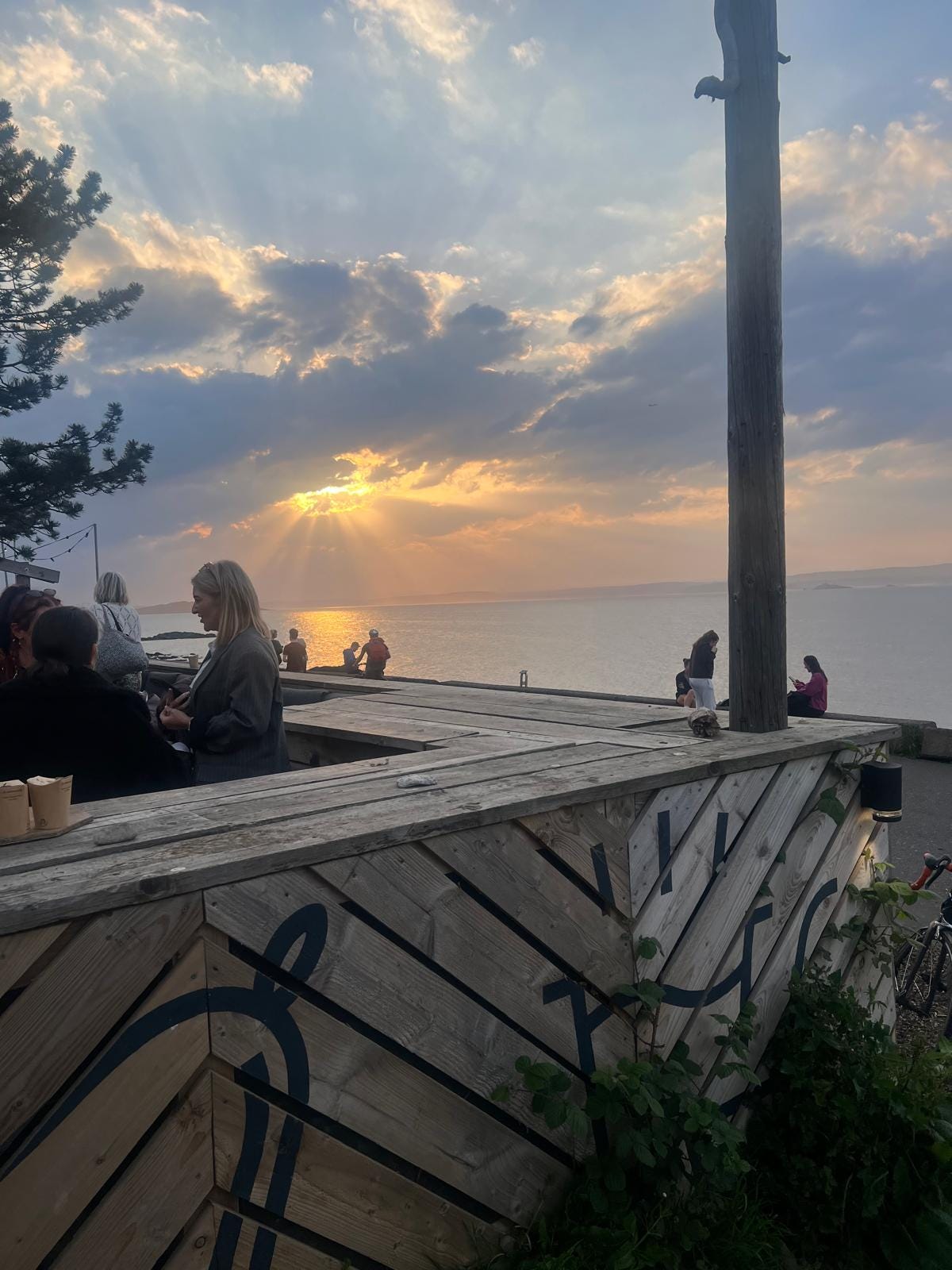
After the sauna, I swam in the sea as the sun set over the bay – still plenty cold enough for me even in summer – and ate dinner from my favourite take-out van, The Buffalo Truck (run by a friend),
Guest post by Gilly
WHO
I’m Gilly, born and raised in the north of Scotland. I’m a climber, cold water coach, illustrator, meditator, and advocate for nature and calmness found in our breath. I’m a coffee lover and cat botherer too, and a sucker for a nice hand-thrown pottery mug.
Back in about 2012, a series of major life events plunged my world into darkness. A tragic death, a serious rock-climbing accident, my glass window to life was shattered to dust. I moved from the city to the relative stillness of a smaller town and took a step out into rebuilding a new life. To piece together this window took time, but over the last 14 or so years, this new window to life has been rebuilt. More vibrant, colourful, and dazzling than I could have imagined. And the seed for this started in a step outside, into the stillness of a cold lake.
I was lucky to have a childhood spent on beaches, the sea and in forests, connecting with natural spaces with curiosity. Somewhere in adulthood, in a corporate job and the busyness of life, this connection to nature was unplugged. Moving closer to nature, this cold connection to my breath and my ‘being’ flooded back again.
My work is now deeply connected to mental well-being and connection with nature. I work with CEOs, charities, sportspeople, businesses and individuals to help them find stillness in natural bodies of water. We don’t even need to get cold and wet to find this stillness, as by simply observing our breath, we can start to find new vibrant stitches for our own tapestry.
WHAT
We are bodies of water, coming from water in our mothers’ bellies; we are 70% water. Our beautiful Earth is also about 70% water; in fact, from space, our planet looks more water than land. Water absorbs our prayers, listens to our grief, and nurtures us at every stage of life, from cradle to grave.
My cold water immersion – deliberate submerging in water about 15 degrees or less, whether sea, lake, river, or bath – is not a new concept, despite recent hype. Hippocrates, the ancient Greek physician and “Father of modern Medicine’ (460-370 B.C.), discussed the benefits of cold water for well-being nearly 2500 years ago. In our fast-paced lives of alerts and noise, with our pocket supercomputer draining our attention, water’s calming spirit quietly waits for our return, for those brave and curious enough to step forward.
WHY
Scientifically, it’s worth noting that there’s plenty of anecdotal evidence of the potential risks associated with cold water immersion, such as hypothermia, cardiovascular problems and drowning. While many individuals report excellent anecdotal benefits, further large-scale scientific research is still necessary and ongoing. Research suggests benefits such as reducing inflammation, supporting pain management, improving insulin sensitivity, alleviating migraines, and addressing PTSD. Other studies have explored effects on general well-being, anxiety, depression, social interaction, and loneliness. However, it’s important to note that while these potential effects have been reported, it is not a magic pill that cures all ailments – sorry Hippocrates!
For me, given the right starting point, whether it’s backed by science or not, a cold dip in nature has helped me rewire my brain and reduce my body inflammation. These days, I’m rarely sick, and I sleep deeply. The overall effect of the cold has led to a greater awareness of what I put into my body and how I connect with nature and sunlight, and it has changed the way I breathe, walk, and engage with the world. The hard experiences of life’s challenges are met with resilience and peace – and this has been found in nature’s arms.
By doing hard things in a way that is manageable, with our own volition, and in a way that’s met with curiosity, joy and an air of non-striving, we can truly rewire our resilience to life’s stresses.
Water in the UK is generally always cold! So it’s always going to have us standing there for a moment, questioning why we are here! Even with 10 years of winter cold under my swinsuit, this thought still pops up.
Some days the pull is strong to swim a distance, other days it’s simply to lie on my back and float watching the clouds. The magic in all of this is that we perhaps don’t even need much cold water at all.
Finding a pocket of stillness, off screens, in silence, with no apps, music, talking, or pixels to steal our attention can help our brains slow to a tick. This stillness can be found in your local park, your garden, or even in a quiet moment with your breath in a supermarket queue. Simply observing it for a few in-and-out breaths can start the journey.
HOW
The route to cold water has many paths, each with its own unique texture of sensation and discovery.
The shower
For many people, the starting point is a cold shower. I find cold showers pretty challenging, and many people do, so don’t be put off. A cold shower is sharp, immediate and accessible. It can become a ritual within everyday life, a simple act of hopping out of bed and washing the morning drowsiness down the plug hole. It’s a superb way to practise what cold water feels like and to navigate your moves on the temperature and time ladder safely. Though it can become tame and a touch predictable, set in a tile-bound glass cabinet with a radio and a rubber duck, it is a great starting point. Hopping out, feeling zingy, with fresh coffee ready – it’s the ideal go-to for anyone wanting a hit of cold without the expense of a tub or the faff of a river. Ending your shower with a cold hit will help the cold-water zing last longer, and there is no need to get your head wet here.
A tub or tank
Cold tanks are popping up in gyms and retreat centres across the globe, offering a more immersive hydrostatic pressure on the body than a shower and, with this, the potential for a longer pause in a meditative state. Like the shower, the experience is (likely!) a solitary one between you and the water. Tubs are great for getting a cold fix in a city garden and for finding a moment to reset when a natural dip isn’t possible.
Again, like the shower, this environment is relatively controlled, with the warm embrace of a sauna or a comforting brew and slippers nearby. The shower or tank requires little time investment or risk assessment, aside from checking with your GP before starting, as with all cold practices.
With Nature by your side.
The wildest, least trodden path to the cold is the journey to open waters: rivers, lakes, lochs and the sea. These places lie beyond the brick walls and back gardens, and can offer a deeply connective, sensory-rich adventure. Every day in this environment, with its winds, weather, weeds, and wild wonders, presents a deeper challenge; each dip and meeting here become more about community and expansiveness, and for many, it allows a more profound reset. These places demand respect, a solid understanding of the risks, and a long apprenticeship. Much like surfers and their local wave or climbers and their favourite rock face, we can become quite intimate, in a beautiful way, with our local water spot over the seasons. Many outdoor swimming spaces are now better equipped and more accessible for individuals with additional needs. It is easy to find groups and organisations to support your journey. In a group, people look out for each other, and that’s the best place to start. It’s wise advice to never swim alone. I do swim alone; however, it’s usually in summer and always along the shoreline. Burkinis for some women, swimsuits in a wider range of sizes, and qualified specialist swim guides are all making a huge difference in removing barriers to entry. There are brilliant, highly portable and submersible beach wheelchairs designed for those with mobility limitations when accessing the water. There’s still a long way to go, but it’s great to see the water becoming accessible to more people.
Like any path, there is no right or wrong way; some require a compass. Let curiosity guide you in your next step towards a cold embrace.
The secret is to find the ‘just enough’ for you. If I were to run a marathon today, having never jogged, I’d hate the whole experience, get injured and likely sell my trainers before nightfall. Treat the cold the same way! Not too cold, not too often, not too long.
A few minutes is all that’s needed; find your starting point and keep going. It’s a new path like no other.

“The Beauty of Cold’ is published by Hachette and is available at all good bookshops.
Easkey Britton – big wave surfer and author of Saltwater in the Blood ‘‘The Beauty of Cold is a love letter to the wild water and the fierce tenderness it awakens in us. Gilly doesn’t just write about swimming – she writes about belonging to the body, the elements and the present moment. Brave, playful and full of heart, this book reminds us all that in the cold, we find our true aliveness’
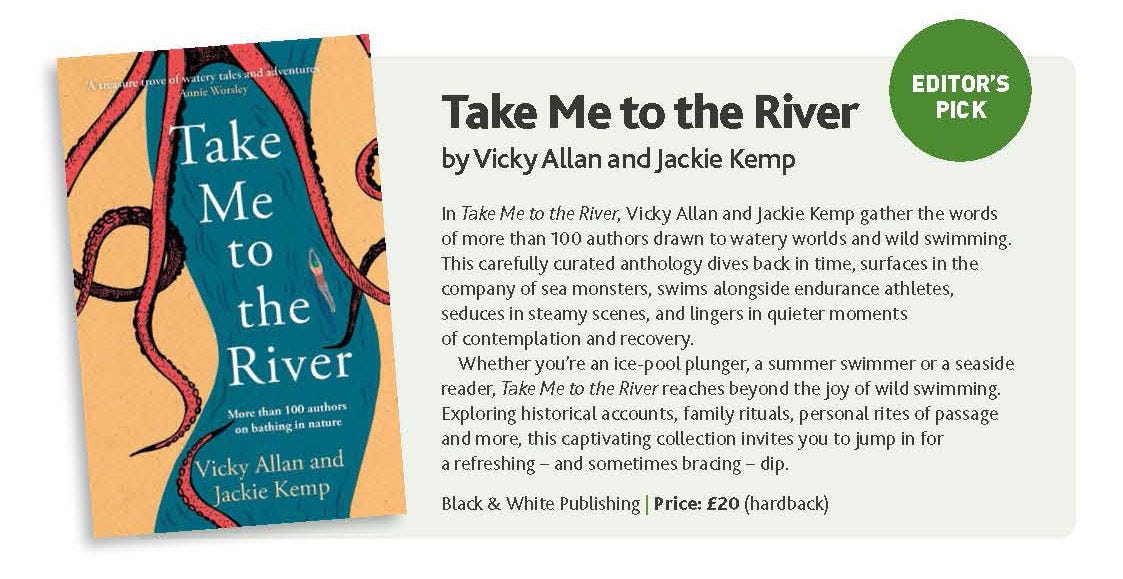
PS. I am pleased to share that Take Me to the River is pick of the month in Lifeboat, the magazine of the RNLI