
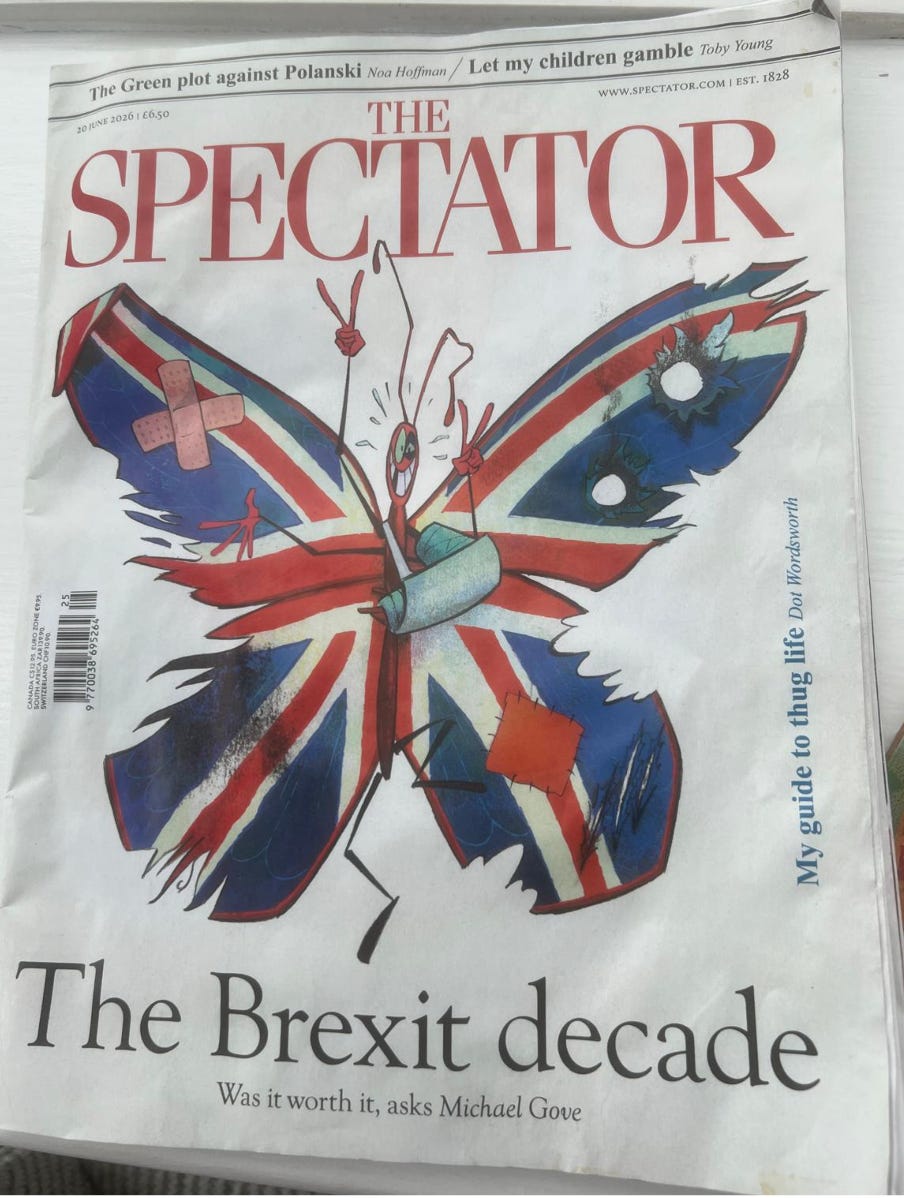
I’ve been working my way through the coverage of the 10th anniversary of the Brexit vote this week, most of which focuses on the damage to the British economy. In an attempt at balance, I bought The Spectator, which had the cover line – The Brexit Decade: was it worth it? featuring an essay by its editor and former Conservative minister Michael Gove, who grew up in Aberdeen.
I handed it over the counter in the co-op on a cool evening in Lerwick in Shetland, where I am on holiday (pronounced Ler-ick by locals we discover). The young man who served me read the title aloud, guffawed and said, “Given that the slogan was Brexit means Brexit which means nothing at all, I would say not.”
I answered that the benefits, such as they are, are all to the EU, which has at least rid itself of a gurning, uncooperative member of the club. The other shoppers in the queue nodded.
My experience is that anti-Brexit feeling is the consensus position in Scotland, where seven in ten want to go back into the EU. I don’t think it is like that in England. Even in London, which voted Remain, the whole Brexit issue is much more divisive than it is in Scotland.
Consulting Michael Gove in a bubble bath in our holiday cottage ( now that’s a horrifying image) I found that, while he admits that Brexit has created a certain amount of economic difficulty, he believes Britain is about to rebound “like the Nike swoosh” – or perhaps like Gove himself back in the days when he admitted having a bit of a taste for the old Bolivian marching powder.
Gove told his readers that, while they might not like it, imposing VAT on private school fees was a government policy that, without Brexit, could have been challenged under EU law. I thought that was an interesting example for him to choose. Aberdeen legend has it that Gove’s adoptive mother took an additional job as a cleaner at the university to pay his fees at Robert Gordon’s. You would struggle to do that on a wee job now.
The other approaching Brexit benefits are apparently that 1) Britain can withdraw from the European Convention on Human Rights with its ghastly clause protecting the rights of all humans, including foreigners, to family life. 2) Britain can introduce gene-edited crops which are vastly more exciting and unpredictable than regular crops, and 3) It can even more slavishly encourage American tech bros to help themselves to content made by UK creatives and keep the cash (OK he didn’t put it quite like that.)
Gove also had the gall to claim – reading this made me so annoyed that I lashed out an arm and knocked my tea onto the floor – that the food and farming sector would benefit.
That is not the case in Scotland, where we are now starting to see the full damage of the post-Brexit trade deals that Boris Johnson’s government, where Gove was a minister, did with Australia and New Zealand. The EU protects its food producers by putting tariff barriers to entry from areas with different conditions, environment and welfare standards. These deals don’t. The EU protects terms like ‘Champagne’ – you can’t for example, put cheap wine through a SodaStream and relabel it – but these UK deals don’t support Geographic Indicators.
Scotland has only a small amount of premium farmland – our farmers cannot compete with New Zealand products on price. Brexit also makes it harder for them to export special, premium meat to the EU markets where it is highly prized.
I am always encouraging folk to eat venison because we have a million deer, who overgraze the Highlands and cause road accidents. I was chatting to a crofter earlier this year who complained the deer are getting through the fences and eating crops. I asked if they could be shot, but she said no because the game dealers won’t take any. It turns out that, thanks to Brexit when you buy venison in a pub or supermarket, even if it is labelled “Highland Venison” it is probably farmed venison from New Zealand.
These are literally (1) ‘fuck you, Scotland’ trade deals. Quebec gets a say in Canada’s trade deals; every member of the EU gets a say in theirs – but Scotland gets no say over what Westminster does.
Scotland is suffering the most economic damage from Brexit of any UK country, in part because it was the one exporting the most to the EU. The Herald had a front page splash last week “Brexit has made Scotland £30 billion a year worse off” on a report that compares Scottish performance against a notional “if Brexit never happened” scenario. That is obviously hard to prove. But the other interesting data point is that Northern Ireland, which is still effectively part of the EU, has overperformed against the same trajectory. (Except the port of Larne which has suffered from the shift of trade flows towards the Republic. If only they could mine irony.)
Gove, who left Scotland aged 18 for Oxford, where he was a leading light of the debating society, was the only Scot who was a leader of the Leave campaign and also the only one (apart from Alister Jack the Scottish secretary) in the Cabinet in the Conservative government which delivered it.
The government which called the Brexit referendum had only one MP representing a Scottish seat. The one that delivered it had six, ten per cent of the available seats. Gove was in both of these governments, representing a seat in Surrey.
When it was put to the vote, Brexit was rejected unanimously by every council area in Scotland and the country as a whole voted convincingly 62% for Remain. There was no ‘referendum lock’ to ensure that the constituent countries of the UK all had to agree. There was no attempt to get any kind of buy-in from Scotland afterwards.
Like much of the coverage of the Brexit anniversary, Gove’s article made no mention of the fact that ten years on, three nations of the UK – Scotland, Wales and Northern Ireland all have First Ministers who want to leave the Union.
Since 2016, support for Scottish independence has shown no sign of falling back from this historic high and has continued to poll at around 50%. (If you exclude ‘YouGov’ the last six months of polls average about 53% for Yes.)
In Northern Ireland in 2015, support for a united Ireland was just 15% – now it is usually around 42% – but one recent poll had it as high as 61%. This is a massive rise in a decade. The prospect of a united Ireland is much closer than it was.
Gove writes of “ we the British people”, but Brexit was not a British project. It was an English one, carried by the disproportionate weight of England’s electorate. Scotland is not, and never was, on board. Brexit has deepened a rift that was already widening. One day, Michael Gove may be remembered as the Scot who did most to deliver independence.
Read Measuring the Regional Economic Cost of Brexit: Evidence 2026
Read more about Scotland and Brexit, and about the impact on farming.
Scotland’s million deer problem
(1) Literally is used for emphasis here, as is the f word