
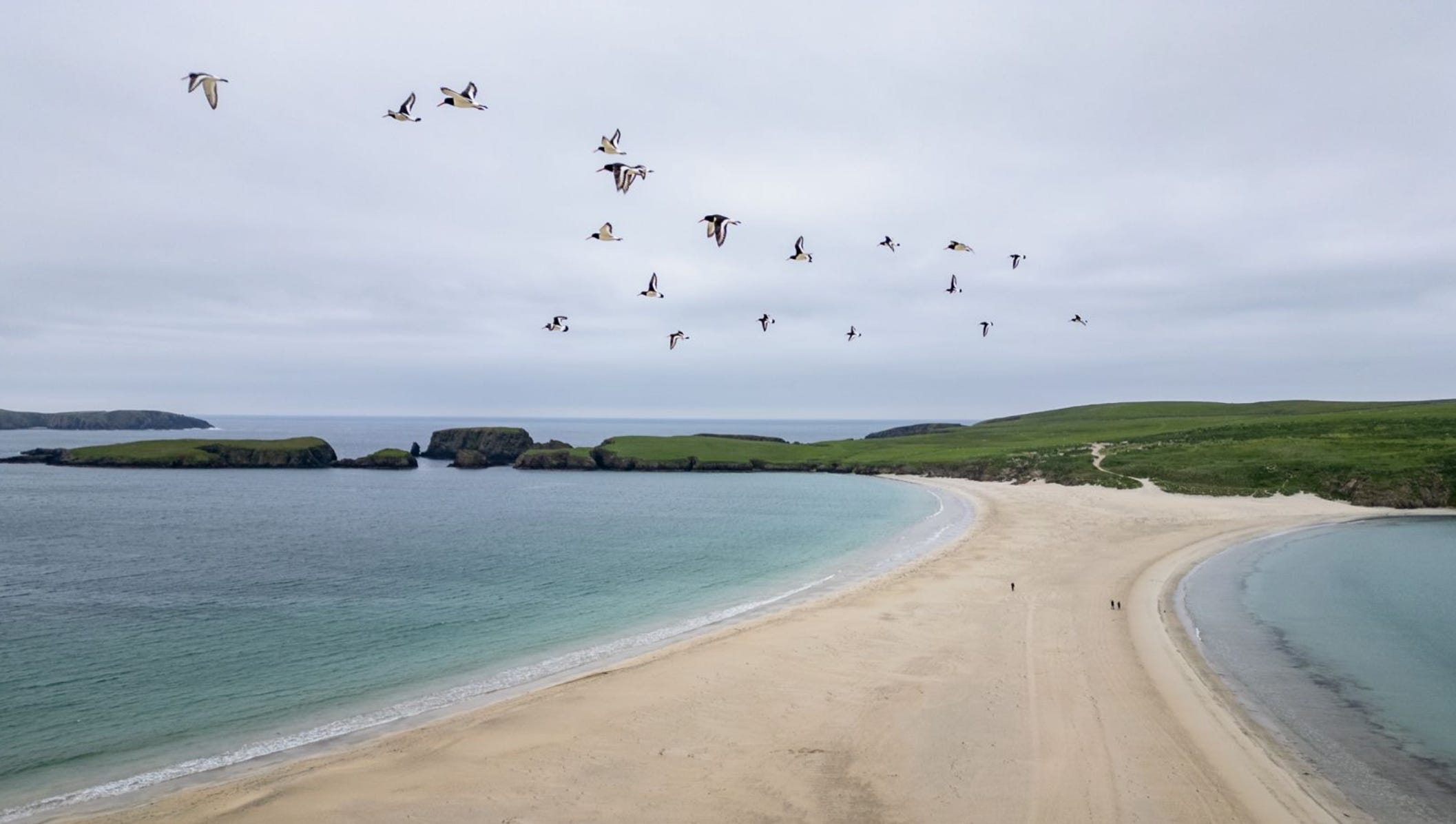
On Shetland last week, I found myself in an outhouse watching a man brandish a gleaming knife over a corpse. He sliced ritualistically into its pink flesh…
Just like an outtake from the TV series Shetland – but in this case the body was of a salmon, not a murder victim. We were at a tasting session at Handmade Fish near St Ninian’s beach, the tombolo of golden sand that appears on the show’s credits.
I don’t generally eat farmed salmon because of concerns about the environmental impact of the industry. But I had a bit of a rethink after meeting Dave Parham, who has purveyed smoked fish to many prestigious customers, including King Charles, over the last quarter century. I am keen on slow food, and food doesn’t come much slower than this – it takes a week for Dave’s Handmade Fish Co to produce three.
Dave comes from fish stock (in Devon) and he could wield a filleting knife before he could write. He gets his supplies from Shetland-based Scottish Seafarms and argues that this is a better-run operation than most. SSF supply Marks and Spencer who, according to Dave, take a pretty hands-on approach to quality control. SSF also has a French ‘Label Rouge’ quality mark for which they have to maintain lower stock density.
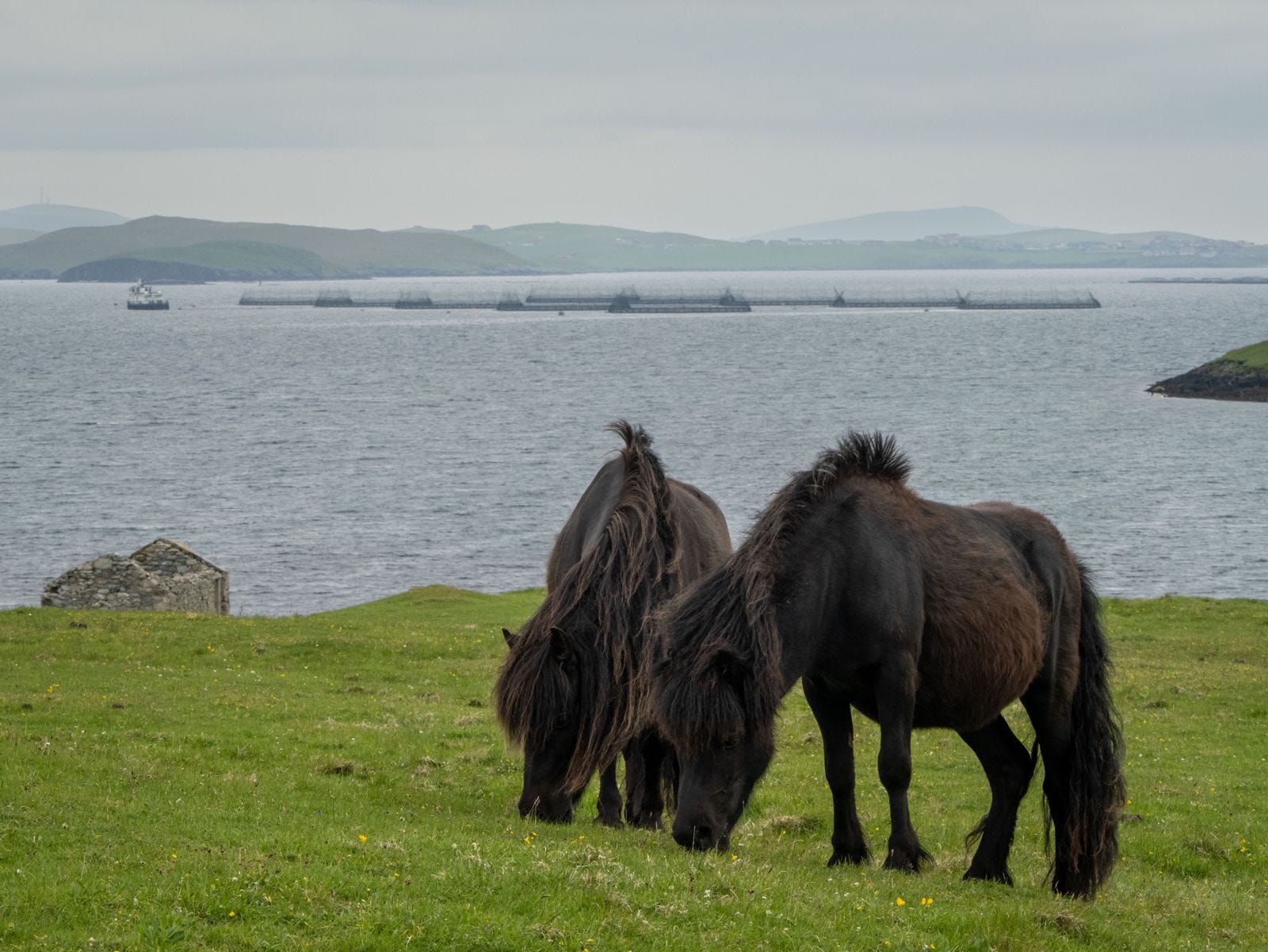
I do accept that fish, including salmon, is going to be farmed, and not all farms are inappropriately sited (like the one in Loch Torridon I wrote about here). But concerns remain. One major one is that deep-pocketed aquaculture firms go around the world hoovering up small fish for feed. That could be Antarctic krill that humpback whales rely on, or sardines in the Indian Ocean. When I hear about the industry expanding in Scotland, I tend to imagine small boats fishing all night off the coast of Africa and finding their nets empty in the morning, like the Apostles before the miracle at Galilee.
Dave didn’t know much about this, but when I researched it later I found that the clever Chinese have found a way of turning carbon dioxide and hydrogen into a nutritionally perfect alternative fishmeal, a process which they are scaling up. (This is the kind of energy-intensive enterprise that Shetland could attract with a Shetland tariff ).
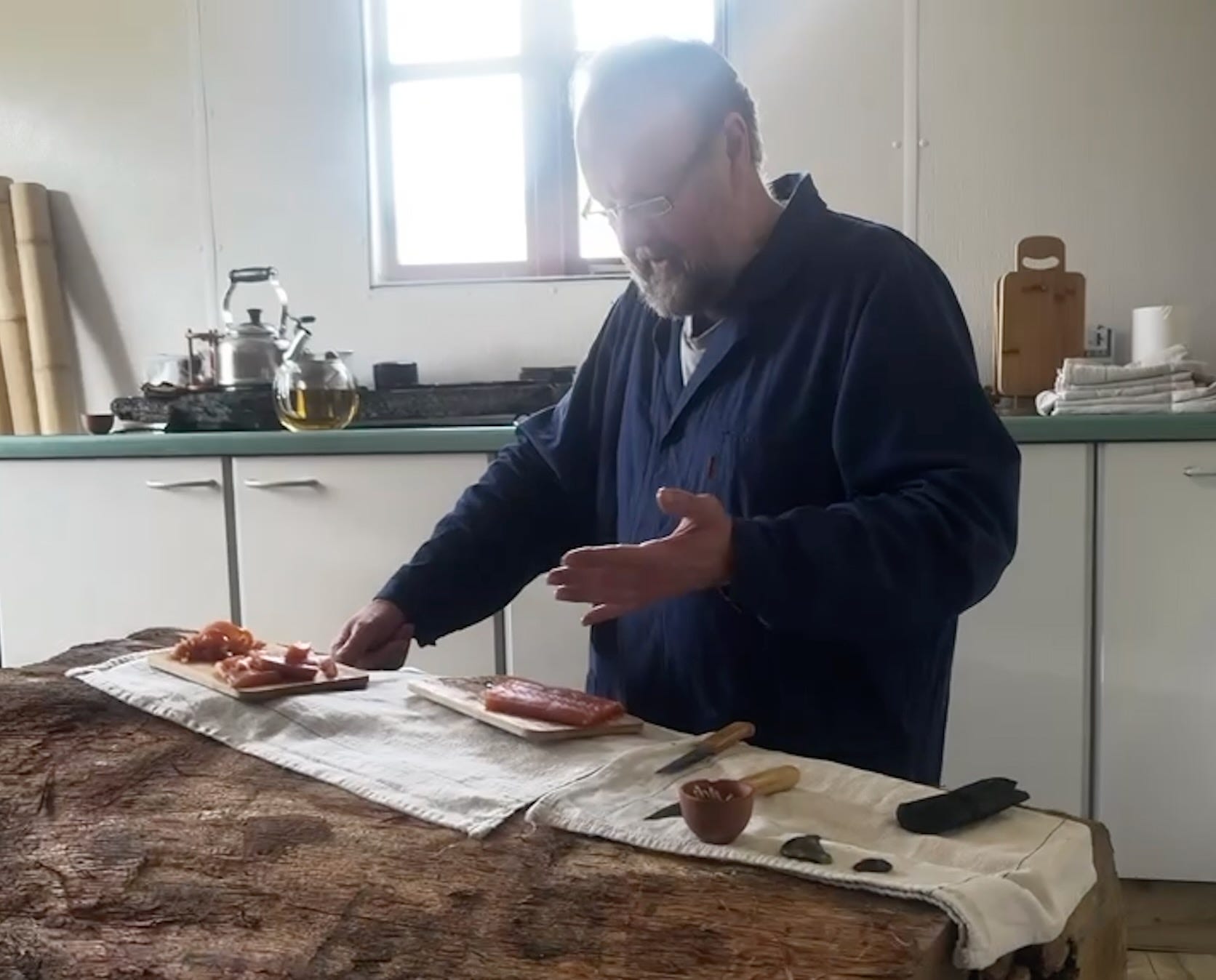
Back in Dave’s shed, he showed us the massive oak trunk that he brought to the island and painstakingly grates to make sawdust (the wood cost far more to import than to buy) and a bag of binchotan, fancy Japanese charcoal that imparts an umami flavour. Sampling different parts of the fish was a bit like a wine tasting. We came up with terms like “citrus notes,” toffee-apple”, ‘Laphroig”, “unctuous” for our tasting notes.
Salmon is not the only farmed seafood on the archipelago. We noticed long lines of ropes stretched out across bays as we drove around. This is a global hub of another farmed seafood industry – mussels.
One of our young associates was vegan for a couple of years, but she did eat mussels – ostroveganism it’s called. Mussels are OK with ethics girls because they are single-celled organisms without pain sensors and can be farmed sustainably because they live off particles in the water.
In search of some for dinner at our holiday cottage, I drove over to Blueshell Mussels HQ one morning. The admin manager Beth, who has worked there for ten years, explained that they didn’t have any mussels that day. Samples are tested every morning and when the water is warm they spawn, which is normal for the time of year. (In the West Highlands we have noticed a dieback of mussel beds which may be linked to warmer waters but Shetland so far is plenty cold enough – as I discovered while swimming each morning.)
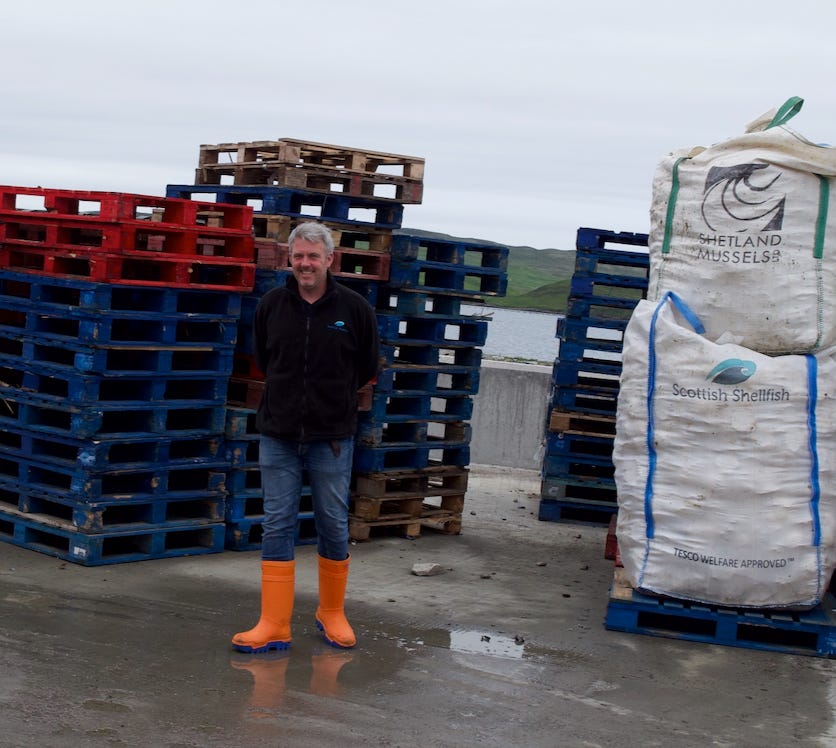
I fired a few more questions at an operations manager called Callum. Blueshell is locally owned and works with four large and a couple of smaller local mussel farmers. The farmers are responsible for the crop, which takes about 18 months to grow. They harvest mussels by boat, and Blueshell collects them by road in small vans. Back at the depot, they load the mussels into larger lorries which head to Lerwick for the ferry to Aberdeen. From Aberdeen they go to fish markets at Larkhall and Billingsgate and from there to the rest of the world.
In the absence of mussels, I was offered scallops which they also handle. I asked if these were hand-dived. Around the West Highlands, scallop dredgers have done a lot of damage to the seabed and our favourite restaurant the Gille Brighde sells only that are hand-dived locally with minimum environmental impact. Callum said they don’t do hand-dived scallops on Shetland, but they are fished in line with the island’s specific marine regulations.
I decided that I didn’t know enough to argue with a fisherman in orange wellies about this – for all I know it is too deep and dangerous to dive for shellfish off Shetland so I shut up and said I would buy some. Later, my research showed that dredging around Shetland does have strict regulations that are tailored to their particular conditions.
I paid £23 for a kilo. They were a good size and tasted great with capers and brown butter. I did also get to eat some delicious Shetland mussels, served in a garlic and white wine sauce with broad beans, when we visited No 88 in Lerwick.
All this seafood made me think about how we see food (sorry). It is not easy to evaluate the environmental impact of what we eat – there are so many ways to measure it. Campaigners do important work highlighting harms that the industry is not transparent about. Some of what we know or think we know is to do with the stories we hear and tell – but these may not always be reliable or up to date. As when watching Shetland, you have to look out for red herrings.
Jackie and Vicky Allan are speaking at Fittie Community Hall in Aberdeen on Sunday, July 12, at 2 pm, as part of the Festival of the Sea. Join us at the beach for a dip after. Book here. Under 18s free and the event will be family friendly.
Gilly McArthur will join Jackie and Vicky at the National Library of Scotland on Thursday, July 30 at 5.30 pm. Book here.