We are hearing a lot about the USA’s 250th birthday – what about India? Today is India’s 80th Independence Day.
It has come a long way since leaving the British Empire. Male life expectancy in Delhi is now about 74 years, which compares favourably to Glasgow’s East End where it is about 69.
On that first Independence Day in 1947, life expectancy was 32 years, and there was severe food insecurity. The literacy rate was just 15%. Literacy rates are now about 77%.
India has its challenges – the recent “cockroach” protests over youth unemployment and hyper-competitive exams have shown that. But India is a democracy with lots of successes to celebrate.
Its innovations include Digital Public Infrastructure (Listen to this podcast interview with one of the architects of the India Stack). It is moving fast on the transition to renewables – it has met its Paris Agreement target on installed renewable capacity ahead of time.
Stepping away from the Jenga
Britain did not step away from the Imperial Jenga carefully in 1947 – in fact it threw a massive rock on the top and ran away. (I have just finished listening to the audiobook of Sam Dalrymple’s magnificent Shattered Lands – I heard him talk about it last Edinburgh Book Fest and it has taken me a whole year to catch up with it but it was worth the wait.)
Lord Mountbatten accelerated the timeline for Indian independence from 18 months to just 77 days – we don’t know why, Dalrymple suggests it was down to complacency and incompetence.
On the first Independence Day, it had not yet been revealed where the line had been drawn between India and Pakistan.
That fateful line was drawn by a chap with a map – Cyril Radcliffe had never been to India before. He was given five weeks to divide a landmass of over 175,000 square miles, cutting through farmlands, villages, water networks, and communities based on outdated census data and maps.
On August 15, 1947, Radcliffe did not celebrate. He was terrified and ashamed. He refused his fee, burned his papers and fled, never to return to the Asian subcontinent.
The line was announced on August 17, sparking the biggest forced migration in human history and horrendous violence.
He who rules the ledger
India was a rich country – it was known as the Jewel of the British Empire – but somehow most of the money always seemed to be owed to London.
The core engine of this financial illusion was a category in the Indian budget known as Home Charges. These were bills for the “cost” of administering India from afar – the India Office, salaries and pensions of an army of civil servants and the interest on India’s “Public Debt” – a debt calculated by London.
People sometimes say that the British Empire created an amazing railway network. This is true – but Indians paid for it. The money for railways, canals and irrigation protects was borrowed from British banks and interest had to be paid to them.
There was also the cost of foreign wars. Whenever the British Empire wanted to expand its global reach or fight a war outside of India, including in World War I, it deployed the Indian Army – and charged India.
India consistently ran a massive global trade surplus by exporting high-value goods like tea, cotton, and spices. Logically, this should have made the nation incredibly wealthy. However, London intercepted this wealth using a financial instrument called Council Bills.
Foreign merchants wishing to buy Indian goods could not pay Indian merchants directly in gold or silver. They had to buy Council Bills from the British government in London. London kept that hard currency and gold. The foreign merchant then took the paper Council Bill to India, where they could exchange it for rupees collected from local Indian taxes.
You can’t eat cash crops
This system helped to create the conditions for repeated famines when millions died, from the 19th century to the 1940s. Because they had to pay the heavy taxes that were owed to the colonial government, Indian peasants could no longer afford to grow traditional food crops like millet and rice for themselves.
They had to grow cash crops like tea, jute and cotton. When conditions changed, they no longer had food reserves in local granaries and were immediately vulnerable to famine.
The Salt Path
India’s famous independence leader and pioneer of non-violent direct action, Gandhi, led one of the first protests against the British Salt Act. This gave the British government a monopoly on the manufacture and distribution of Indian salt.
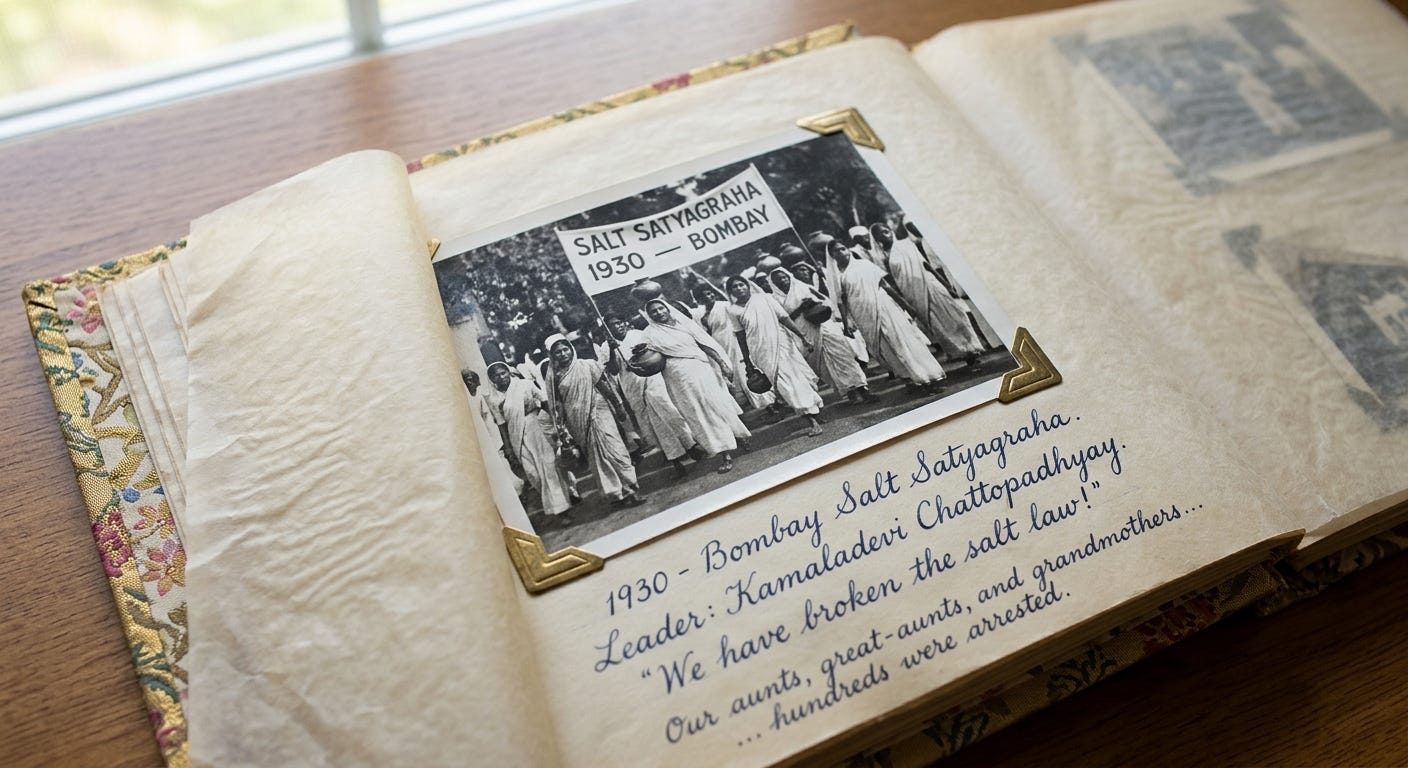
In 1930, Gandhi led marchers and the international media through some desperately poor areas, to show the living conditions there, before illegally making his own salt. Millions followed and women publicly joined the freedom struggle en masse for the first time.
Sam Dalrymple quotes a participant in the protest: “Even our old aunts and great-aunts and grandmothers used to bring pitchers of salt water to their houses and manufacture illegal salt. And then they would shout at the top of their voices: ‘We have broken the salt law!’”
Women led the protest
I looked into this at bit more, interested in these women-led protests. On one occasion, Indian independence supporter Kamaladevi Chattopadhyay – where have I heard that name? – led a large crowd of women to the beach in Bombay to evaporate salt water on charcoal stoves.
The women were charged by British police who hit them with heavy wooden steel-tipped poles called lathis. Kamaladevi was knocked into a fire pit but, despite severe burns, refused to leave.
As women fell, others carrying pots of salt water rushed to take their places. Hundreds of thousands of people were arrested or jailed for possession of illegal salt and the salt protests were eventually suppressed. But over time, resistance only grew.
The other side of the ledger
The financial system broke down during the Second World War when Britain paid India in IOUs for resources. At independence, Britain owed India huge sums. It did a deal over gradual payment – mostly in British goods. When sterling was devalued a couple of years later, India lost about a third of the value of the debt.
Changing the future
Indians must take British images of the Raj, like the ones we get from the Merchant Ivory movies, with a very large pinch of salt.
You can’t change the past of course. And it is impossible to say where India would be now if it had never been a part of the British Empire It may have avoided the famines and violence of Partition but it could still have been a very unequal country – it had Imperial rulers before.
India built on and expanded the system of government that Britain imposed. It has ended up as a parliamentary democracy like Britain’s other former colony, the USA.
India is judged by international standards to be a flawed democracy – but so is the US – and, well, the UK has the House of ‘Lords’.
India today is a young country full of highly educated people – hopefully they will lead the way on some of the issues that face us all, such as dealing with climate change.
Happy 80th Independence Day to India