
If there is one thing calculated to annoy bright young things who have to veil their individual style under ugly purple t-shirts in order to work long shifts for low pay in a cellar, it is the sight of a couple of old Etonians slouching to the front of the bar queue to demand another bottle of Champagne for their mates: “don’t worry about payment – just put it on our tab”.
Over the years, many young people have worked for Ed Bartlam and Charlie Wood at Underbelly at the Edinburgh Fringe. Fair or not, the guys have a bit of a reputation.
So you could almost hear the eye-rolling from space when Ed Bartlam launched an attack on the Edinburgh Fringe Society. He called it “bloated” and urged it to “get back to basics”. In a nutshell, he seems to mean that the Fringe Society should stop working so hard to give all performers equal access to connect with the audience and let the purple cow and the rest of the Big Four help themselves to audience share first.
Ed and others wrapped themselves in the cloak of concern for performers when making their attack. But actors don’t make money out of the Fringe – venues do.
Ed and Charlie did start out as humble student actors looking for a dank space to put on their musical based on the work of the Marquis de Sade. They discovered the neglected spaces of the Cowgate – where noblemen once had their palaces – and an idea was born.
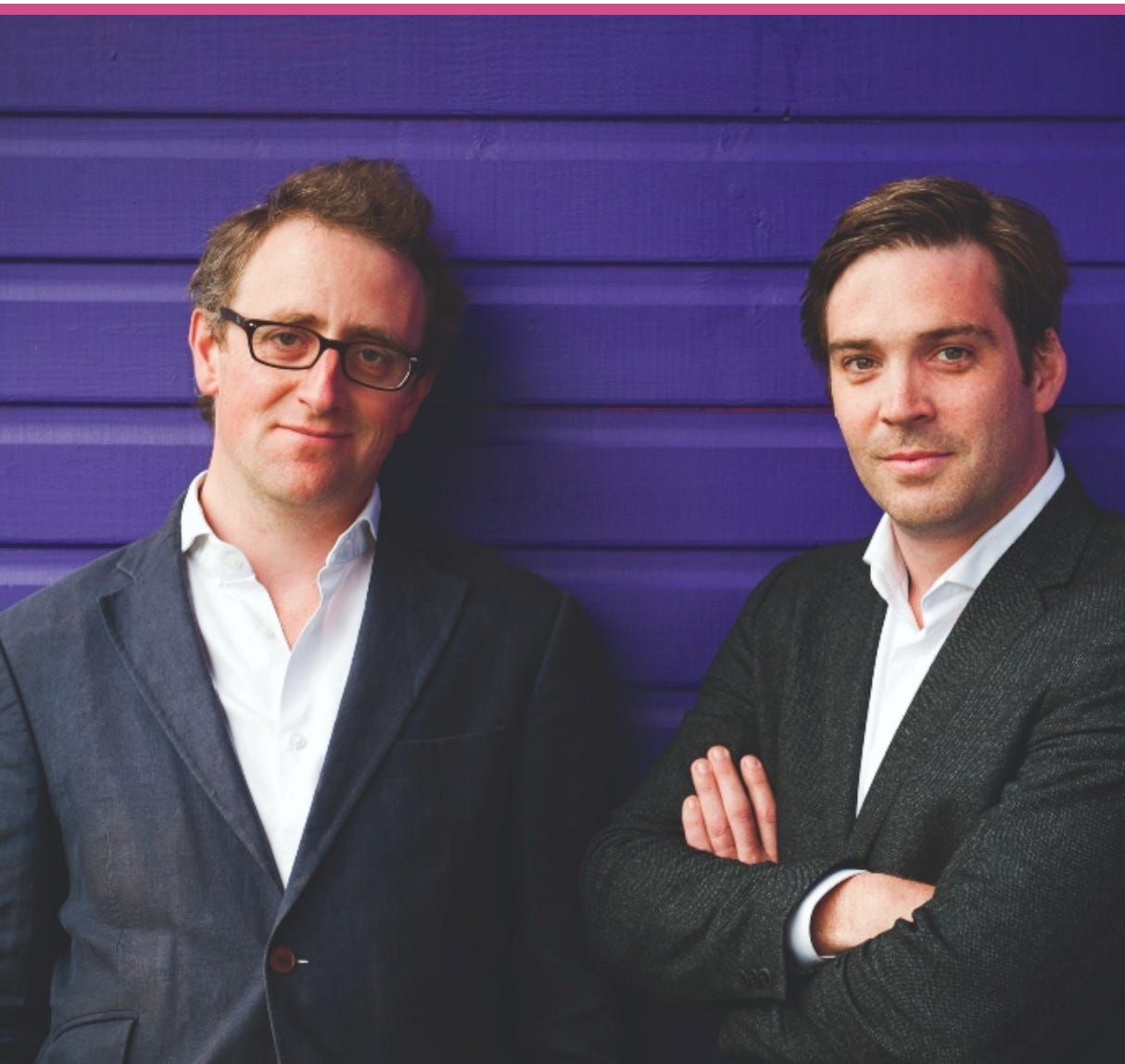
They built up from that first venue and now run four hubs, 20 stages, sprawling drinking areas and thousands of performances, all cow-themed. (Their VIP area is called The Abbatoir). It gave them a platform to launch shows in London’s West End and elsewhere. The image above is from an interview with them in The Stage in 2017 entitled: “The fringe needs large venues. We take the risk on big shows”
But things may not be going so well now – they recently announced that they are closing the London venue they took over three years ago, Underbelly Boulevard Soho – putting it down to the cost squeeze. Costs have indeed been soaring for live entertainment and Edinburgh even more so – as Fringe producer Francesca Moody told the Guardian.
The best years for Underbelly’s business were the 2010s when ticket sales were going up, build costs were manageable and most years made a profit. It is a private company and its accounts are private, but it is reasonable to assume that over the fat decade, Ed and Charlie netted in the ballpark of £10 million in salary and dividends.
During the fat decade, though, Underbelly weren’t keen to share their profits with the staff – it took a Fair Fringe campaign backed by UNITE in 2017 to make them improve pay and conditions. (The Fair Fringe campaign was across all the venues, but many of the complaints were about Underbelly.)
Underbelly is one of four big gatekeepers – Underbelly, the Gilded Balloon, the Pleasance and Assembly. These run curated programmes and do their own marketing, PR and ticketing (though they sync with the Fringe Society ticket platform). Pleasance is a charity (which uses its status to avoid paying Fair Fringe wages – volunteers get help with accommodation and pocket money); Assembly is a hybrid whose bars fund its operating costs; the Gilded Balloon is also a business, but it appears to have been much more fiscally conservative than Underbelly.
Ticket sales were soft and unpredictable over the last couple years in Edinburgh – but so far this year it has been very busy. That bounce – maybe caused by hot weather elsewhere and it could fade as the Fest ends – is partly to blame for the skeleton staffing levels. But Underbelly seems to have hired about 500 seasonal staff this year, the same number as when they were running a much smaller operation.
To be fair, it is a similar story at many venues this year – they have also cut back on the number of higher-paid supervisors and managers, loading the weight of big sites with thousands of drinkers onto the shoulders of too few young people.
A friend said that it has become a very different job: “It used to be that you would take a job at the Fringe and you would work hard, but you would have a laugh, you could stand at the back of a show for ten minutes and think, I’ll come and see that on my day off. It is not like that now. Everyone is totally maxxed out all the time.”
Like other venue operators, Underbelly are running on the good will, energy and extra effort of their staff – they are certainly not bloated and at times close to the limits of what is acceptable. Bloated – no. Exploitative? Maybe.
That is the background to Ed’s attack on the Fringe Society. The Fringe Society is a charity, which exists to help performers and audience find each other in a complex environment. Their mission, “to give anyone a stage and everyone a seat,” is built on the founding principle of remaining an open-access festival with no curator, artistic director, or gatekeeper determining who can perform.
Coming to Edinburgh in August is expensive. Short-term rents are astronomical. But those who are really determined, who are prepared to sleep in a van at a Park and Ride car park and shower in a yoga studio can still find a way. You can still get a spot in the back of a pub like the Richard Gadd character in Baby Reindeer, in the pay-what-you-can free Fringe.
But once here, it is a tough fight for audience share. The high rents affect audiences as well as performers. The Fringe Society reaches out to that potential audience, showing them how they can come, how they can plan a short visit, how they can navigate what can seem like an intimidating event.
Their online ticketing platform offers features like geolocation – for example shows near you starting in an hour. That could include Bolton School doing Henry V in a church crypt round the corner, maybe featuring the next Ian McKellen. It is not just going to point you to a famous London comedian talking about his divorce at the Big Four venue where you already are. Hmm, what’s in that for gatekeepers like Ed and Charlie?
New Fringe Soc chief exec Tony Lankester has said that the charity’s costs compare favourably with others across the world – but so far his response has been overly apologetic. Let’s hope he is simply finding his feet and will then stand firm and defend an operation that gives every show, no matter how small the venue or how unknown the performer, the exact same billing as any other.
DIRECTOR’S NOTES
The back story
My claim to fame is that my grandfather Robert Kemp, a Scots playwright and broadcaster who is little remembered now, coined the phrase the Fringe. He wrote that the world was exhausted after World War Two and the Festival was inspired by the idea of taking up the threads again, of restoring the broken continuity and the international friendship of art.
At that first Festival in 1947: “An important, and totally unforeseen development was the growth of “the Fringe “ – those companies which came to Edinburgh at their own risk and set up shop in all sorts of little halls too small for the uses of the official Festival. I am not sure that they have always received cordial approval, for a good deal of money is spent on sponsoring the event and there are a lot of impudent youngsters competing for the money…
Yet all things considered, “the Fringe” has brought experiment, liveliness and adventure into what could easily become a stodgy mixture. If a great deal of its charm is simply that it gives young people a chance to show what they can do, it has on several occasions uncovered work of real merit.
That is and remains the spirit of the Fringe and without the 50-person crew of the Fringe Society defending it, the Underbelly would destroy it.
Nevertheless, despite this year’s take on the perennial squabbling without which no arts festival would be complete, I would like to end on a positive note. Researching this blog, I re-read one of the last things my grandfather wrote before his unexpected death from a stroke at the age of 59 in 1967. It was an article for the Scottish Field about the 21st anniversary of the Edinburgh Festival:
It so happens that I write these words on the very day when when fighting has broken out between Israel and the Arab nations,. It is impossible for me to tell whether the war will be confined and stopped by the intervention of the United Nations or whether the worst will happen. I find myself thinking, “Here I am writing of the 21st Edinburgh Festival as if I were sure that it would occur”…
I ask myself “Have we been grateful enough for the Edinburgh Festival?” At first, I think, we undoubtedly were. We had crossed one desert and our throats were parched. But as the years passed, people seemed to be more critical. There was more girning of one kind or another. Something of the simple gaiety and enthusiasm wore off. Foolish and meaningless stunts seems to be stealing attention from performances sometimes so close to the ideal that there was little to say about them.
Twice before in my life I have seen Europe go dark and watched the doves of peace having their necks wrung. I must still have faith that mankind has not gone entirely mad and that somehow a general war will be averted. If that is so, we shall have our 21st Festival. The old city will be floodlit, in her streets strange tongues will be heard. Great artists will weave their spells, and we shall gladly submit to their enchantment. We will be able to share again, in some of the most glorious creations of the human spirit.