
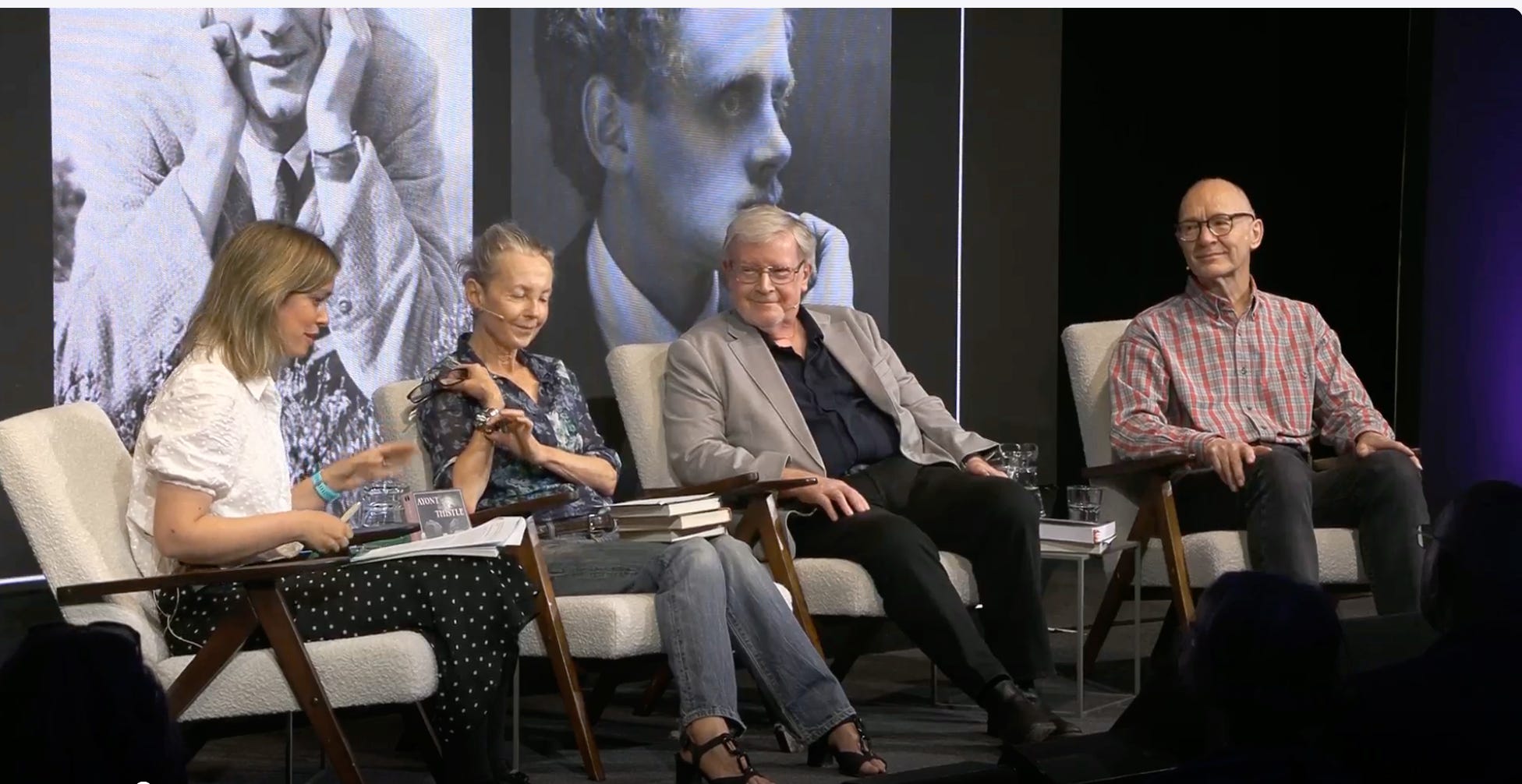
At a packed Edinburgh International Book Festival event featuring three of Scotland’s best-known literary figures: Kirsty Gunn, Alan Riach, and James Robertson, I got the mic at the end to ask a question.
The event marked the centenary of Scotland 1926 – a high-tide in Scottish culture when Neil Gunn’s The Grey Coast, Hugh MacDiarmid’s long modernist poem A Drunk Man Looks at a Thistle were first published, and work by Nan Shepherd and other women writers was emerging.
I said – I didn’t put it as well as this at the time – that politics is downstream from culture, so is it possible for someone to love and be proud of Scotland’s literary tradition but also to argue that Scotland should not be allowed a vote on its constitutional future?
My question was motivated by a recent flyte – a debate among Scottish scholars, though a polite one by historical standards.
Scots language campaigner Billy Kay, in a podcast for the National, said that the tradition of patriotic Scots who are also Unionists is dying out.
Kay said: “I’m thinking of people of the calibre of Walter Scott in the 19th century or John Buchan, the great writers who were patriotically very, very Scottish and champions of Scottish culture, but who were politically unionist, who just thought that Scotland was best served in the Union. Because of the rise of modern nationalism, I think that brand of unionism almost has died a death.
”I don’t know anyone like that nowadays. I knew people personally from some of the old Tory families … like say George Young or the Buchanan Smiths, or Sandy Irvin Robertson, who was a great character in the wine trade, who’s since deceased. They were all very patriotically Scottish, but they were Scottish Unionists, and they belonged to a tradition”.
Walter Scott was the most famous of these – Kay recalled a story told in The Democratic Intellect by George Davy where Scott, who was a lawyer as well as a writer, was going down the Mound with some colleagues.
“They’re discussing the fact that there were three government commissions in the 19th century set up to try and bring the Scottish universities into line with English universities because they feared this democratic intellectualism. They were kind of joking about it. And Scott burst out crying on the Mound saying, basically: ‘You lot will not defend Scottish culture. And eventually, there’ll be nothing left to defend because of your attitude.’ Whereas he was so patriotically a Scott, that he couldn’t stand to see the erosion of his culture as he saw it at that time. So that’s a good example of that different mentality.”
Kay goes on to say that nowadays Unionists find any positive interpretation of Scottish culture politically threatening, so they have to use their energies to demean and belittle it. In a thoughtful online only article in The Spectator, Stephen Daisley disagreed but he accepted that Kay has a point:
Anecdotally, opponents of independence remark to me now and again that they feel alienated by Scottish symbols, in particular the saltire, which they consider the nationalists to have hijacked. But he [Kay] misunderstands his foes when he suggests that ‘a fear of Scottish identity and Scottish culture among Unionists is motivated by anxiety over the inevitability of independence’. In my experience, there is no one more complacent over the future of the Union than the average Unionist. Try engaging them some time on long-term polling trends in Scottish identity and constitutional preference. It’s like trying to explain the concept of temperature to a frog in a gently simmering pot.
Another riposte to Kay came from one-time Glaswegian shopping mall pianist (before things went downhill and he became a right-wing journalist) Fraser Nelson, who tweeted that Kay was wrong. Mike Small in an essay in The National and on Bella Caledonia, took Nelson on:
When challenged about whether he couldn’t see a contradiction between being a ‘Patriotic Scot’ and someone who didn’t think we could run our own country or even be allowed to vote on our future, Fraser replied: “Not really. I want my fellow Highlanders to run their own affairs so I back policies that allow them to keep more of the money they earn. Empowering some other part of bureaucracy is not freedom.”
Small went on to analyse a Substack essay that Nelson posted back in February. On a rare trip back up the road from London, Nelson went to see a famous painting in Kelvingrove Art Gallery, The Last of the Clan. It shows a family patriarch left alone on the shore while his family is forced to emigrate. Discussing the Clearances, Nelson focused on the “chasm” between Highland and Lowland culture at that time. Small sees Nelson’s work as part of a tradition of saying that the different parts of Scotland are so distinct that Scotland is kind of not really a country. That would kill Scotland’s right to self-determination stone dead for sure.
I’m not sure that this is an entirely fair reading of Nelson’s essay – he passes from the subject of the Highland Clearances to muse on rural depopulation more generally. The Japanese Noh all about that – as in the Book Festival’s Scotland to the World series. A top group of Noh practitioners gave a haunting performance inspired by Kathleen Jamie’s essay On Rona, about visiting a priestly shrine on an uninhabited island, which has echoes in their own rapidly ageing country. (The programme described Kanji Shimizu who played St Ronan as a shite actor – I was initially surprised as I thought he was amazing, but then I discovered that it is pronounced shi-tay and means the lead performer – every day is a school day).
Scotland is a country of many stories, divided by lochs, seas and mountains, a little like Japan, or Switzerland with its cantons, but it is a country nevertheless and one of the oldest in the world. I am sure Nelson would recognise that – but I do see what Small was getting at.
Kenny Farquharson is someone who is very at home on the turf of Scotland’s literature, culture and history while at the same time a Unionist. On his Substack, he recently published a 6,000-word essay on the centenary of A Drunk Man Look at a Thistle.
In it, Farquharson argues that MacDiarmid’s Scots is an ersatz concoction assembled from different dialects. That is true, of course. After the Union of the Crowns in 1603, Scotland lost its court and the Royal patronage of Scots writers and poets that went along with it, and it started to decline as a literary language. The writers of the Scottish cultural Renaissance, like MacDiarmid, did consciously try to graft new shoots onto old branches gathered from around the country.
In the book that was connected to the event Ayont the Thistle: A gallimaufry of poetry and prose to mark the centenary of Hugh MacDiarmid’s A Drunk Man Looks at the Thistle, John Herdman writes of the poem: “I think only a few of its constituent parts are individually great poetry – but those few pre-eminently so. But the work as a whole has a huge and undeniable stature which derives from its cumulative, relentless moral force and from the vigour of the Scots language which the poet was virtually creating as a medium for extended thought in verse.”
Farquharson goes from arguing that the poet’s language was synthetic to arguing that the Scottish National Party’s politics is also synthetic. Farquharson delves into MacDiarmid’s dubious politics – like Yeats he flirted briefly with the idea of National Socialism in the 1920s. The link to the SNP today is via the white rose that MSPs often wear, the subject of MacDiarmid’s short poem:
The rose of all the world is not for me
I want for my part
Only the little white rose of Scotland
Which smells sharp and sweet – and breaks the heart.
The Rosa spinossima has a long history – it was associated with the Jacobite cause and MacDiarmid’s poem was taken from a speech by Compton Mackenzie, author of Whisky Galore and co-founder of a precursor to the SNP (the National Party of Scotland) in 1928. It is tenuous at best to deduce from that some taint of fascism, as Farquharson seems to do.
To be fair to Farquharson, he is essentially arguing that independence supporters are also uncomfortable with the past. Also true – but we don’t have to share all of the attitudes of our forebears to be proud of our heritage and to think Scotland can be considered enough of a country to be able to claim the right to self-determination.
Farquharson would accept this – he is one of very few Scottish Unionist commentators who is urging the Labour Party to end its sullen refusal to discuss another independence referendum. Instead, he argues, there should be cross-party agreement on the threshold for one.
Back to my question. James Robertson is the author of And the Land Lay Still, The Testament of Gideon Mack and other titles, and co-founder of Scots language children’s publisher Itchy Coo.
Robertson said: “I’m in the middle of writing this short, short history of Scotland, which is 900 years in about 300 pages. I’m going to have to leave a lot out. But one of the things that strikes me as I do that, worked my way through that process, is that Scotland is its entire history seems to be, and this may be true of other countries as well, about new beginnings. At every point, there’s a new start, fresh start.
“I think that it is possible to be part of this culture and and to not actually think that Scotland should be an independent country, but I think that’s getting increasingly difficult, partly because the context in which we can remain as part of a union is being demolished every day.
“We can’t ignore the fact that for 300 years we have been part of of a of a political union, and that’s part of who we are and part of our history, but I think those days are coming to an end, and I think that means there has to be a reassessment of what it means to be part of of of Scottish culture as opposed to a wider British culture.”
Professor of Writing at Dundee University Kirsty Gunn, whose The Big Music is one of my favourite Scottish novels, answered the question by saying: ”Go and read Alan’s new collection of poems because he has a very good poem about exactly that”.
Professor of Scottish Literature at Glasgow Uni Alan Riach said: “OK, you’ve asked for it. The new collection of poems is called What the Sea Gives, and there’s a poem in it called On Changing Your Mind, and its dedication is to those who voted No, and who would now vote Yes, and I’ll leave it at that.”
That dedication could have been written for me. I have written before here about how I voted No to Scottish independence in 2014 and how I started to change my mind almost immediately.
One of my good friends, who also voted No in 2014, still fears the uncertainties independence would bring and might prefer some kind of federal solution. He might abstain but he says he won’t vote No next time, because he doesn’t want to be the guy who killed Scotland’s dream of a better future. (Can I say that abstaining will be a bit like voting Noh? Japanese experts, please comment).
The title of Riach’s forthcoming collection What the Sea Gives is a nod to a list of Scottish poetry books that was hallucinated by Chat GPT, one of the others being A Sundial in St Andrews by Kathleen Jamie.
Riach didn’t read his poem out at the event so I asked him to send it over, and here it is.
Alan Riach
From What the Sea Gives (Edinburgh: Luath Press, 2026)
On Changing Your Mind
(To those who voted no and who would now vote yes)
– You must remember that people can change their minds.
– It’s an honourable thing to do. And to say so.
It’s good to keep an open mind.
(‘A mind as open as the grave’?
Not only that. A mind as open as the sky.)
It’s simple. Things change.
You change as you perceive things,
Understand them, more deeply.
It’s sad that understanding did not come before,
When fear or caution gave you pause,
Or different persuasion brought different commitment,
Or different commitment obscured the necessary openness.
But men and women have their reasons, the need is not
To dwell there now, but see to say that,
With a patient thoughtfulness, your reasons change.
The courage of conviction needed,
To say that change has happened,
Is itself a virtue, to be praised. It’s simple.
Difficult. Courageous. Not for everyone.
Cowards still will cling to the dreck,
Make false promises, rationalise, be seen through,
While helping hands are spurned,
Or grasped and pulled in towards the maelstrom.
But you make your statement simply, quietly.
You were wrong, some say, now you’re right.
But absolutes are water-tight and not true human things.
The open mind, the deep commitment, decision now to act
Upon the seen and understood, is always good.
I send my salutations to your courage,
My gratitude for your honesty.