
“It was a good speech – but I didn’t feel Andy Burnham was speaking to me. I just don’t think he gets Scotland”, my friend said over tea yesterday. We met at a cafe, on a beautifully sunny morning, with the leaves just starting to turn.
My friend is enjoying retirement after a long and dedicated working life. But she has had to dip into her small savings already. She worked for a small charity and is now more or less dependent on the state pension.
She is not unusual – according to evidence given to the Scottish Parliament, for between 50 and 60% of Scottish pensioners the state pension is pretty much their only source of income – and that figure is higher for women.
So my friend was concerned to hear that the “triple lock” which has been gently raising the state pension, is to be broken. That makes her future look a little more precarious. The cost of living shows no sign of getting any less and her ability to earn a bit of extra money is not going to get any more.
She was also annoyed because Burnham said the money she would otherwise have got would be taken to fund ‘a National Care Service’. By which he meant – an English Care Service. Health spending is devolved and Scottish pensioners already get free personal care so this proposal won’t affect Scottish pensioners.
I countered that if the UK government decides to fund personal care in England, there may well be what we call “Barnett Consequentials” ie money for the Scottish and other devolved administrations.
One, she said, why did Burnham not acknowledge this point? Talking of a national care service seemed to suggest that he doesn’t see any distinction between the UK and England.
Two, even if extra money does go to the Scottish government, that doesn’t tackle the underlying unfairness of the British pension system.
Britain’s pension system embeds inequality. We have been conditioned to think that the triple lock is unaffordable because we see the state pension as a burden that falls on the shoulders of future taxpayers.
But to my friend and others, the payments they made in National Insurance should have secured their future pensions. In the UK, this is basically a general tax. But many European countries invest money that workers pay in – so each worker is effectively responsible for funding their own future share.
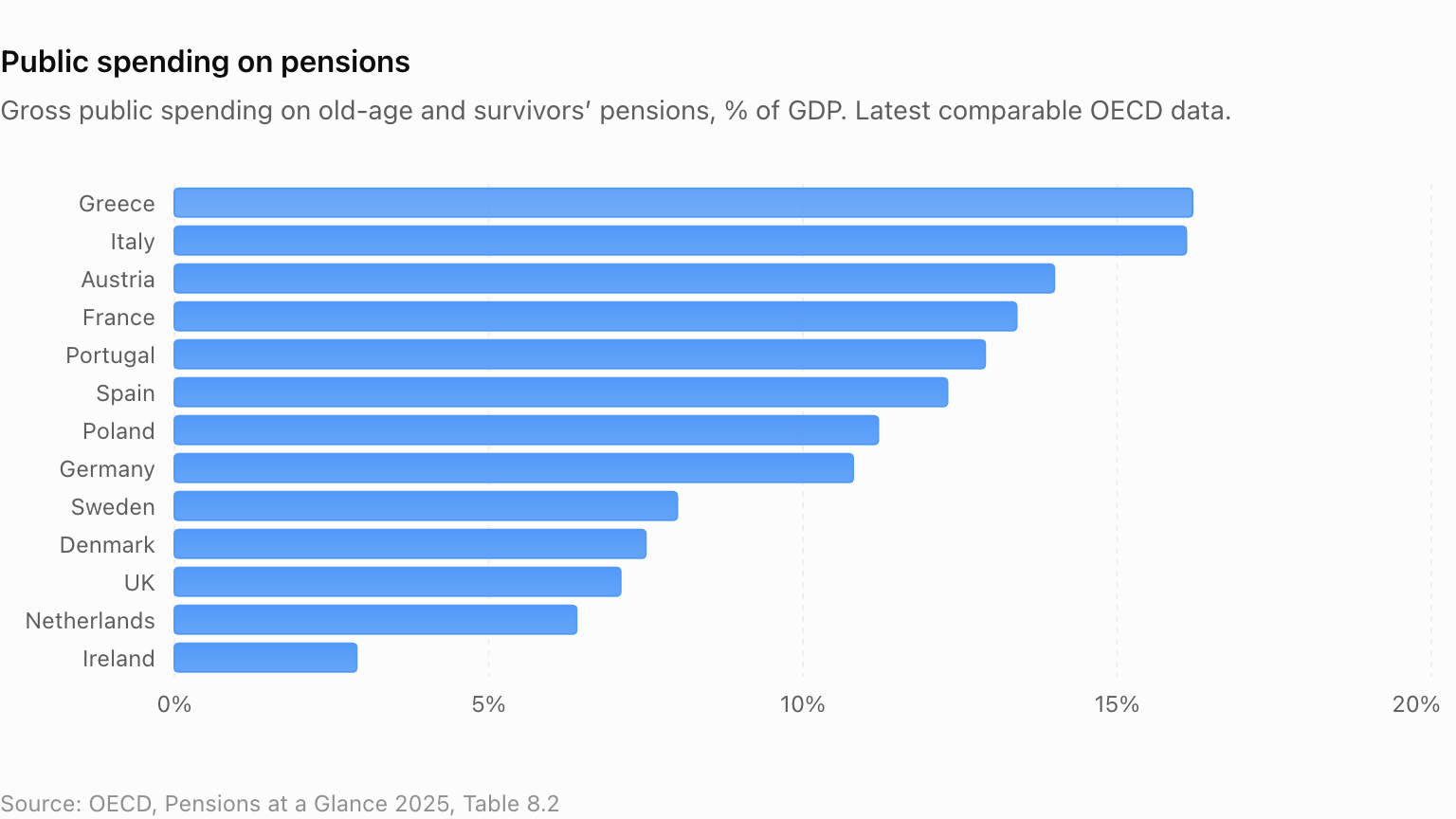
Take Denmark. It has a basic public pension, but on top of that almost all workers contribute to ATP, a nationwide lifelong pension scheme, managed by the government. There is a balancing element for the low paid, carers etc.
The OECD estimates that an average Danish worker completing a full career can expect mandatory pension income equivalent to around 73% of their previous earnings. For a worker on half average earnings, the figure is actually higher than their previous salary.
In Sweden, the basic state pension is mainly for people who had little or no earnings during their working lives. Every year, pension rights are credited to every worker. People also build pension rights while receiving parental, sickness or unemployment benefits, and most workers have an occupational pension on top. An average Swedish worker can expect mandatory retirement income equivalent to around 64% of previous earnings.
Britain’s State Pension, by contrast, is a basic flat rate. Someone who spent their career on a modest wage and someone who earned considerably more receive the same full new State Pension, as long as they have paid NI for 35 years.
Britain is unusual in leaving the rest of pension provision to a fragmented private market. Of course, many people do have good occupational or private pensions. If you’re a doctor or spent your career in a generous final-salary scheme, you may be fine.
But people on low pay, people who move in and out of work, or people who spend years as carers can find it much harder to accumulate substantial additional pension income.
That matters when politicians talk about weakening the protection given to the state pension. For people like my friend, this isn’t an abstract debate about the sustainability of the triple lock. It is about whether the income she expected to live on in her old age will keep pace with the society around her.
My friend also took exception to Burnham’s remark about Scotland’s First Minister John Swinney. Burnham said that on the day his father died, John Swinney upset him by saying that he would be “the last Prime Minister of the UK”. At the time, Swinney was at a meeting in Cardiff with the First Ministers of Wales and Northern Ireland, and he was telling the UK premier to prepare for constitutional change.
Burnham did acknowledge his father Roy’s death was not announced until later – but my friend felt he made the issue unnecessarily personal. Burnham’s defence of the Union seemed backwards-looking, based on shared history, a sense of identity and what his father Roy would have wanted.
But independence isn’t entirely or even mainly about identity. Scots look at the small and medium-sized independent countries around us and see that they are doing some things better, pensions being one of them.
Burnham voiced a desire to fix many issues – Brexit, privatisation of utilities, a Byzantine energy system. But with the best will in the world, how far is going to get? These things were all done to Scotland by governments we did not elect. Over the long term, England tends to elect mostly right-wing governments.
As these golden autumn days turn to winter, there is a little more frost in the forecast for the majority of Scotland’s pensioners. And there are many of working age who do not have much reason to think they will be any better off when they get to that stage of life.
There are good reasons why many Scots look at the performance of the British state and conclude that it isn’t working particularly well for them. They may decide that an independent Scotland could choose to do things differently. That should be our right.