
O wad this braw hie-heapit toun
Sail off like an enchanted ship,
Drift owre the warld’s seas up and doun
And kiss wi’ Venice lip to lip,
Or anchor into Naples’ Bay—
A misty island far astray—
Or set her rock to Athens’ wa’,
Pillar to pillar, stane to stane—
The cruikit spell—her backbane—
Yon shadow-mile o’ spire and vane—
Wad ding them a’, wad ding them a’.
—Lewis Spence, “The Prows o’ Reekie”
Lewis Spence’s on Edinburgh – one of Europe’s great capitals – at least in the centre of town. But when it comes to our seafront, we lag behind what other places like Glasgow or Liverpool have achieved with their once industrial docklands.
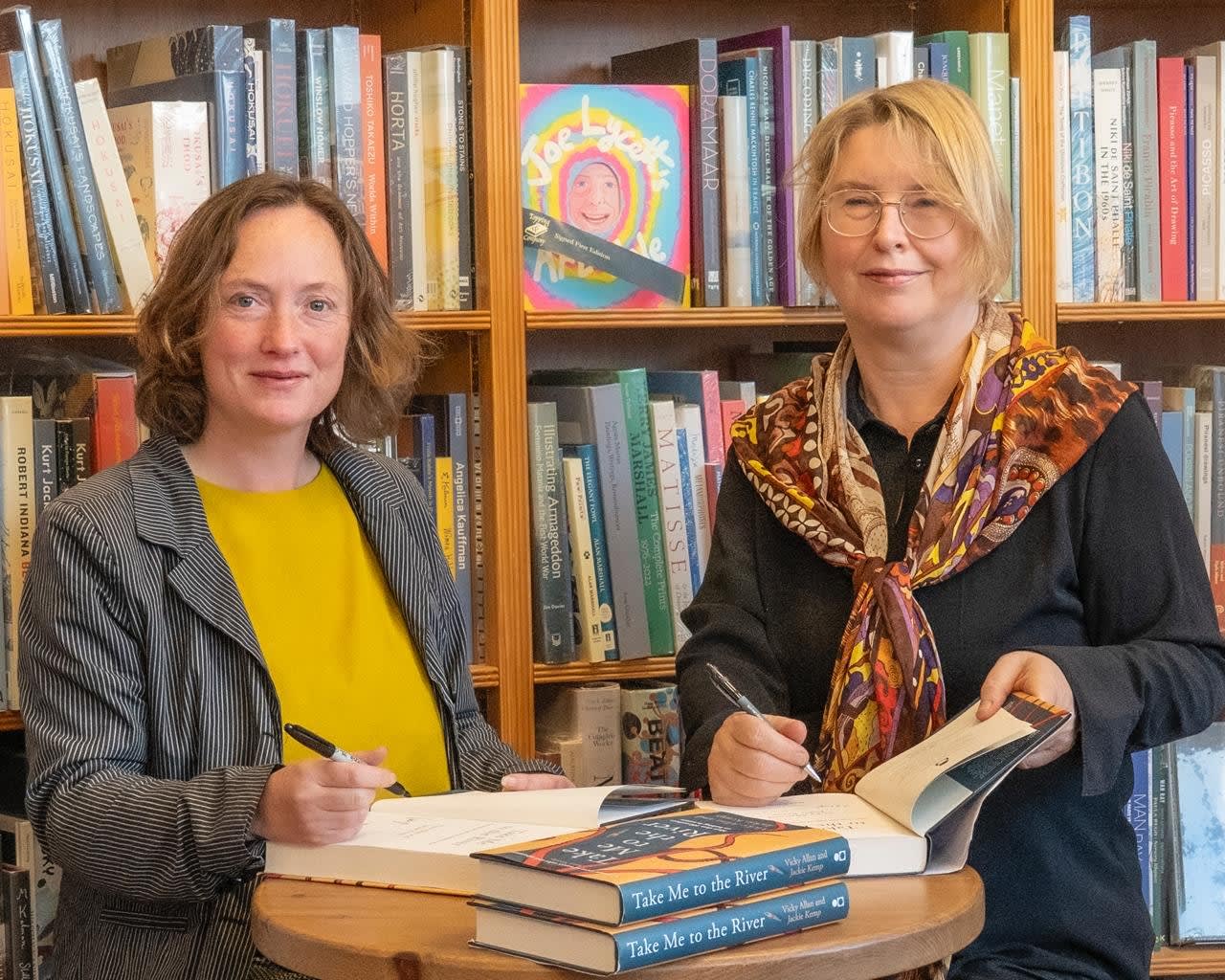
I was thinking about this last week when Vicky Allan and I had the launch party for our book Take Me to the River at the new Pitt market in Granton. Most of Edinburgh’s seafront is not really accessible, so it is great to have this new site, an indoor/ outdoor space with food trucks, a bar, jazz on Sunday afternoons and a sauna complex called Soul Water Saunas. In between heats, if so inclined, you can jump the Firth of Forth, which I remember being told was once translated on a French map as ‘Le cinquième du quatrième’.
No bus goes there yet, so you have to take a ten-minute walk down past the Granton gas holder (it still looks like a disused gasholder but it has actually been turned into a park and the structure gets illuminated for special occasions) then waste ground, then some new housing. “I walked through the Scheme!” one of our guests proclaimed with the air of someone who had arrived by raft down the Limpopo. It is actually a village of tiny houses for people coming out of homelessness built by Social Bite, a charity that hit the headlines when George Clooney worked a shift in their sandwich shop.
The SWS team kindly made the sauna complex available to us, so our volunteer event crew and some friends were able to enjoy a pre-party session and slosh in the icy plunge pools while Vicky filmed them. It was showery and sunny and there was a double rainbow which Vicky captured in this reel.
Before getting into my sequins, I walked out into the water. As I gazed out across the beautiful Firth down towards the three bridges, I said to myself it was awesome. That is a word we throw away but one of the writers in our anthology Bonnie Tsui in her wonderful book Why We Swim quotes some medical evidence that feeling awe is good for our mental health – I guess it leads to what we metaphorically call a sense of perspective.
Access to the seafront is great for our wellbeing – but it is also a way of engaging with the sea itself and what we are we doing to it. For many people, including me, swimming in the sea means you start to care about its health – you notice when the guillemots are coming too close to shore because they are starving, or when the wrong kind of jellyfish are sailing in on the warmer currents.
There is a project hereabouts called Restoration Forth which is trying to bring back seagrass and oysters – I hope they succeed. But most people on the coast of Scotland whether foragers or flounderers, are aware of the die-back of mussel beds and other shellfish – it seems to be happening pretty much everywhere.
Warmer water is a factor – but a recent report in Nature magazine suggested it could also be because of nanoplastics, smaller than microplastics but present in the North Atlantic to an alarming degree. Plastics of course are the flipside of the fossil fuel industry.
Interestingly, when Vicky went down to the sea last week to do a promotional video for our book – one about James Joyce ‘the snot-green, the scrotum-tightening’ sea – a tenner floated towards her on the waves. I joked that the sea had hired her as a consultant – but she pointed out that it is more likely because money too is now made of plastic rather than paper and it doesn’t biodegrade.
West of Granton is Cramond, where the Romans briefly occupied their biggest base in Scotland, at the mouth of the River Almond, where back then fish and shellfish were “inexhaustible and past counting”, according to Roman historian Cassius Dio.
For centuries the Firth was a link between Scotland and Europe – Leith is where Mary Queen of Scots landed after her brief reign as Queen of France. Nowadays she would have to come via Newcastle – Scotland has no passenger ferry to Europe.
There is an ongoing campaign for a ferry from Rosyth to Dunquerque. We sailed from there when a prevoius services to Zeebrugge ran years ago. I remember saying to my uncle that it was worth going abroad, if only to sail home again under the Forth bridges. The Brexit paperwork will be a drag – but Ireland has dozens of ferries to Europe per week – surely Scotland can have at least one?
East of Wardie Bay, close to the Pitt, I don’t think there is anywhere the waterfront is really accessible for six miles until you get to Portobello. Going way back, Leith Sands must have been something like the beach at St Andrews. In Tales of a Grandfather, Walter Scott tells how judge Alexander Gibson was apparently kidnapped on Leith Sands – he used to ride there on his horse every morning without an attendant. A lord (Traquair) wanted a judgment to go his way, so had the judge lured onto a patch of tidal waste ground called Frigate’s Whin and seized. The judge was held in a turret near Moffat for three months and then returned to the beach. Scott writes that all were pleased by the distinguished judge’s return except for his successor. Gibson at first believed he had been spirited away by witchcraft, but a few years later, out riding, he heard the old domestic who had cared for him calling for her cat Maudge.
Scott also describes an army mustering on Leith Sands, anticipating a French landing at the time of the Jacobite uprisings. It must once have been a great sweep of sand.
One of my granny’s favourite books was a classic History of Leith with a grey cover, and I often saw it laid on the arm of her chair. She was very exercised about blocks of flats that had been built in the 1960s, recalling her shock at seeing them rise and realising there were no windows on the seaside. She just couldn’t understand why an architect would do that.
There was a lot of development in the late 20th century which changed the waterfront for good – the tidal flow of the Water of Leith was blocked off by dock gates, the docks expanded. A sewage plant was built on the waterfront to treat the city’s wastewater before sending it out to sea. Along the permanently traffic-choked Harry Lauder Road, the dog and cat home leads on to a long row of car showrooms which mostly turn their backs on the water. Ian Rankin sets one of his murder mysteries along that stretch, noting the lack of seaward windows.
Portobello, when I was young, was pretty down at heel. I went with my grandpa for the penny waterfalls and a Mr Whippy, but it was shabby. This little song captures the vibe:
On the beach at Portobellae
Maggie fell in wi a fellae
His hair wis black and his teeth were yellae
On the Portobellae beach
Now it’s changing – lots of young families, lots of wild swimmers, a sauna on the prom, the rowing club, stalls selling matcha latte and doggy ice cream. It’s popular again.
Edinburgh has spent decades with its back to the coast and its mind somewhere inland. But the signs are there – from Granton to Portobello – that we’re remembering that we are a city on the Forth. Let the prows of Reekie point seaward again.