
Rishi Sunak told the Guardian yesterday that he is: “British, English and British Asian”. Of course he is – but can he not be English Asian?
If you Google “Scottish Asian” you come up with the Scottish Asian business awards which have been runing for two decades, and a range of tartans – the Singh, the Chinese Scottish and a Scottish Islamic tartan.
If you Google “Black English” you get mainly stuff about linguistics; if you Google “Black Scottish” you get Black Scottish TikTok.

I am not saying that there is no racism in Scotland or that there are not people attempting to “gatekeep” Scottishness as Torgi Squire discusses in his TikTok feed, but, as Gavin Esler notes in his book How Britain Ends. Scottish identity is much more open than English.
From ancient times, the inhabitants of Scotland have been a mixture of refugees and adventurers. Back when people travelled by sea and not by land, the Highlands and Islands of Scotland were more connected internationally than London.
Middle Eastern refugees built the Stones of Stenness
Visiting Orkney, I realised that this archipelago was not always seen as the remote edge of Britain but was once at the beating heart of the maritime world. All along the waterfront in Stomness, the houses once had piers that stretched out into water, allowing ships to moor there and take on supplies.
The earliest stone circles in the world are in the Middle East, so travellers from there must have brought the practice west through Europe, building the Stones of Stenness in Orkney about 5,400 years ago, the first in the UK. There are many of these circles throughout Scotland, particularly in the North East. The groups of new arrivals must have started by building these as the centrepoint of their communities, used for feasting as well as for mapping the stars.
The Declaration of Arbroath records that the Scots: ‘Journeyed from Greater Scythia by way of the Tyrrhenian Sea and the Pillars of Hercules, and dwelt for a long course of time in Spain”.
The music of the people of the burrows
Some argue that Gaelic music contains echoes of very ancient music that came from ‘the people of the burrows”, the brochs and wheelhouses that are unique to the Highlands and Islands.
More than a century ago Marjorie Kennedy Fraser was a musical explorer who travelled to record the music of the Gael.
In the book she compiled with William Gibson, Songs of the Hebrides, she wrote:
The Western Sea is wide and the Isles are many, and the old life and the weird tales and the queer songs and the sore tunes are all for the wanderer; for him who has sailed in the smacks and crossed by the fords and waited the ferry; who has heard runes chanted to.the rising sun and to the new moon; who has seen mysterious rites of healing and saining in the dim crusie-light ; who has frequented the midnight ceilidh of many clans and districts who has helped the folk of the shore-clachan to dig for sand-eels in lonely bays under the full moon; who has spent long evenings with the wandering tribes, in the hazel wood, by the side of the burn ; and who has camped out with ancient herdmen whose talk was of the old droving ploys : men mixing their cattle and their oaths at the toll-house, and clinking their glasses and joining in the chorus at the ale-house, on their way, by Kintail and Glengarry, by Lochaber and Rannoch, to the lowland trysts.
She theorised that the scales that survive in the music, which are also found in China and Japan, have a common origin.
Why have these scales been preserved only here and in an ancient civilisation like that of China and Japan? The best known tunes of the daoine-sith or mound dwellers are pentatonic, as for instance, the favourite “ Crodh Chailein “ in the pentatonic Do mode, as also the “ Tha mi sgith “ in the pentatonic Re mode.
That the mound-dwellers had music of their own, and that the Gaelic-speaking dwellers above ground borrowed it when they got the chance, is implied in many an old folk tale. Sian, soft sorrowful music, issued from the green knoll, and the “ slender women of the green kirtles and the yellow hair “ sang lullabys and love songs. The old women in Barra, from whom I collected songs, spoke of the Fairy tunes as having been sung, not by the daoine-sith, but by the “ bean anns a’ bhruth “—the woman of the burrow. Since it is believed that the people who inhabited the mound-dwellings were probably, like the Finns and the Lapps, of Mongolian origin, may it not be that their racial scale was the pentatonic formula, that this passed from them to the Gael, and from these again, by a process of filtration, into Lowland Scotland?
For this ancient five-tone scale permeates all Scots folk-tonality, and as the Celtic tongue, literature and culture are more ancient than the Lowland speech and folk-art, we may reasonably suppose that Lowland music in this, as in many other respects, is indebted to Highland.
Kennedy Fraser’s theory was supported when the oldest musical instrument ever found in Western Europe was uncovered in the High Pasture Cave on Skye in 2012, dating from about 2.300 BC.
I went there last summer, after dropping a friend at the ferry port for the Hebrides in Uig, on a mild, overcast evening with occasional bursts of sunlight – what our friend calls “the Jesus hands’ when a shaft of light appears from the cloudscape, like a spotlight.
Mine was the only car parked in a layby near where Google maps said the cave was and I let myself off the road through a farmyard gate. I climbed up a green field where some sheep were grazing and wandered along the banks of a singing burn towards where it had dug a small tree-lined gorge into the hillside.
My search was pleasant but fruitless, and I was about to give up when a couple from the north of England in a car with a kayak on top swung into the layby. Si was a caver who had checked the location on a proper cavers’ site and it didn’t take him long to find the place. By the water’s edge in the gully there was a lower entrance with a metal pail in it, and at the top there was a hole with duck boards around it.
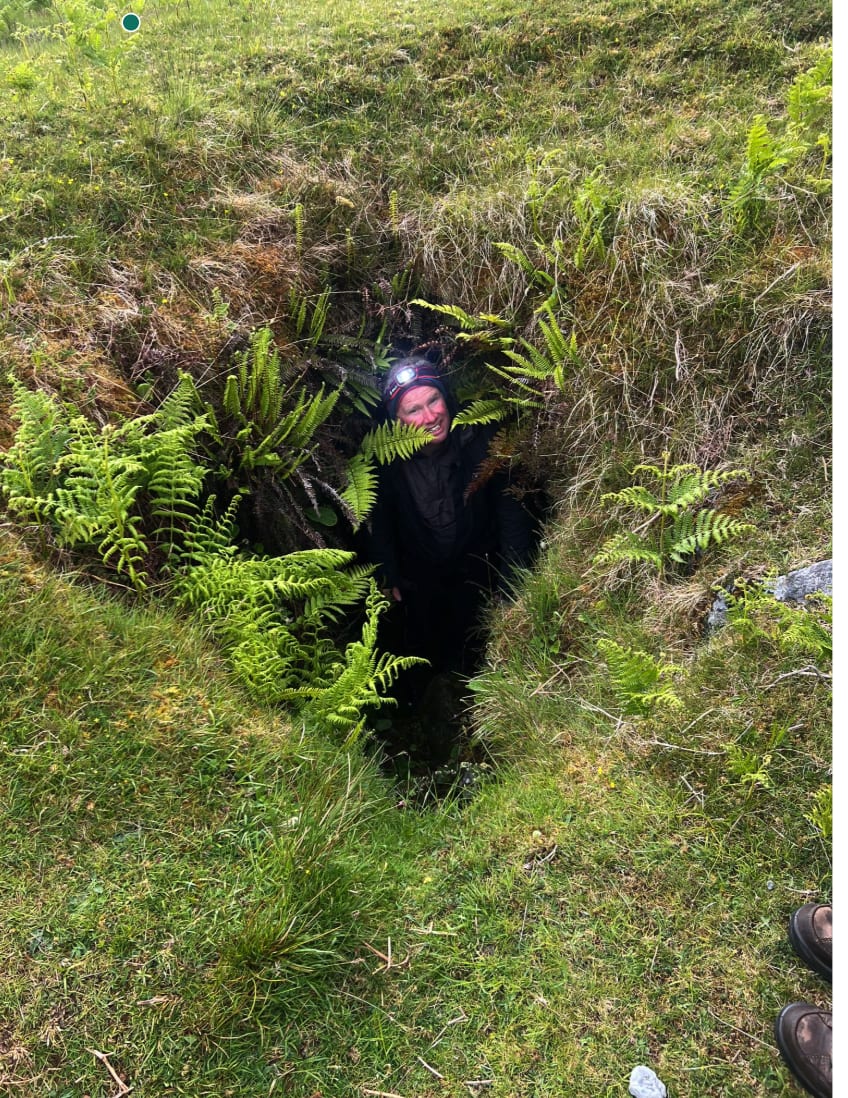
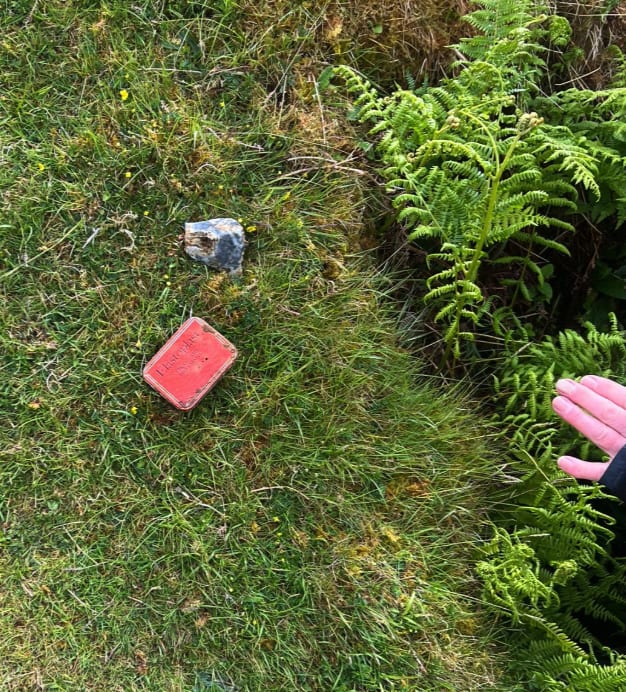
Si donned his miner’s helmet and dropped into it while Kerry waited to one side, with her hands in her pockets, her expression somewhere between long-suffering and irritated. Si eventually emerged with a treasure trove of odds and ends, including a tin of elastopast from the 1950s. He said that there were all kinds of junk in there. Perhaps that is one reason it took archaeologists so long to find the ancient fragments of the lute.
“Picts” is what we call the guys who fought the might of the Roman jack sandal
Five millennia after the stone circle builders and two after the lute makers, we think of Scotland as being occupied by fearsome blue-painted Picts. But the people we call the Picts were not an ethnic or even a linguistic group. They were disparate groups of tribes who got together to fight the authoritarian might of the Roman jack-sandal. They never called themselves Picts – that was the Roman word.
The Picts are also a sub-group of Celts – from the Greek ‘Keltoi’ – the hidden people – because “Celts” is really just what we call the non-Roman tribes of northern Europe. The Celtic fringe ended up being confined largely to the western edge of Europe not because of ethnic difference, but because most of the rest of Europe got Romanised. Scotland was never really part of the Roman Empire and that was why it held onto Celtic languages and culture.
The modern era
I don’t need to labour the points. Scots travelled widely in modern times – many were enthusiastic participants in the British Empire – Scotland’s Empire by Tom Devine is a readable exploration of that. William Dalrymple’s book The White Mughals focuses more intimately on a couple of examples.
So the corollary of the British Empire was that this freedom of movement worked both ways – some of the people from the counties Scots helped to rule came back here.
Then, in the EU, Scots knew that if the worst came to the worst, they could always take a bus to Berlin and play the bagpipes in Alexanderplatz, or get a job as a gardener in rural France.
The corollary was that every Highland hotel you walked into was staffed by charming summer staff from Warsaw or Vienna, young people who spent a season or two in Scotland, and some stayed and settled down.
That was fine – Scotland has a falling birth rate and a demographic problem and plenty of green space to build houses if we could just get the land ownership sorted out.
The “mongrel tradition”
I borrowed the headline about the mongrel tradition from the late William McIlvanney. In Stone Voices Neal Ascehrson recalls the upsurge in protest and campaigning in the early 1990s that finally led to the re-establishment of a Scottish Parliament. He quotes McIlvanney’s speech at one of the biggest marches ever held in Scotland, which took place when Edinburgh was hosting the summit of the European Community, as the EU then was.
On the last day, there was a demonstration, a march ‘for Scottish Democracy’. As a member of ‘Common Cause’, one of the organizing groups, I had not expected a big turnout in chilly December weather. Twenty years in the ranks of the devolution campaign had taught me that Scots would rather vote for constitutional change than walk for it.
But as soon as I joined the marchers tramping up the Mound with their banners, I saw that something had given way. The procession was immense. Some 30,000 people, touched by the sense that Scotland was under the eyes of Europe, made their way to the Meadows and asked for their country back.
Out of many speeches, I remember only one, and snatches of it are still quoted by many others who remember. The novelist William McIlvanney is the one writer whose face is recognized in any Scottish street. He is a witty, elegant West of Scotland man, a working-class teacher and orator whose Kilmarnock ancestors came from Catholic Ireland. McIlvanney looked out over the faces stretching away towards Salisbury Craigs in the distance and he said: ‘Let’s not be mealy-mouthed about all this. The Scottish parliament starts here, today!’
When the clapping died down, he went on: ‘We gather here like refugees in the capital of our own country. We are almost seven hundred years old, and we are still wondering what we want to be when we grow up. Scotland is in an intolerable position. We must never acclimatize to it – never!’
And then, in a tone of tremendous pride, he said this. ‘Scottishness is not some pedigree lineage. This is a mongrel tradition!’ At those words, for reasons which perhaps neither he nor they ever quite understood, the crowd broke into cheers and applause which lasted on and on.
After that December mobilization, the game was up. The Tories knew that they were doomed; Labour knew that they must deliver Scottish self-government as soon as they came to power. McIlvanney was right: the parliament had started that day. And yet what survives from those moments on the Meadows are his proclamation of Scotland the mongrel, and the joy those words released.