Should hospital food be free?
Spending money we don’t have on food for patients who don’t enjoy it makes no sense. There is a better way, argues Jackie Kemp. Published in the Scotsman op-ed section on August 29, 2013.


Spending money we don’t have on food for patients who don’t enjoy it makes no sense. There is a better way, argues Jackie Kemp. Published in the Scotsman op-ed section on August 29, 2013.
The rich tapestry of Scotland’s past, long neglected, downplayed and overshadowed, is finally being given the prominence and attention it deserves, writes Jackie Kemp Published in the Scotsman op-ed section, September 3, 2013
A slightly shortened version of this arrticle appeared in the Herald magazine on Saturday, August 24,2013. Photos are available to view on the website
http://www.alexhewitt.co.uk/gallery-list 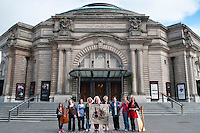
From the Herald Saturday Magazine, May 11 2013. Just as ‘slow food’ generally tastes better than fast food, slow transport – at least on holiday – is a more enjoyable way to travel. Better still when the travelling is done in the sunny south of France, in the shade of plane trees and with frequent pit stops. Whether by bike or by barge, the journey along one of France’s grandest feats of pre-revolutionary engineering, the Canal du Midi, is increasingly popular.
Published in the Education Guardian, August 6 2013
Their exam system may differ from the one in England, but Scottish students face the same anxious wait for their results. Jackie Kemp takes a closer look at Highers and university entrance north of the border
The new Scottish national curriculum will emphasis research and thinking skills
Today, across Scotland, young people will be whooping or groaning as the results of their endof – school exams, the Highers and Advanced Highers, are revealed. “The people who do really well will post them on Facebook,” says student Ellie Small, “and some of those who do really badly might post them for comedy value, but I don’t think I will be posting mine. I’m really nervous. The closer it gets, the more I feel I won’t have got what I need.”
From The Scotsman, Published on 21/05/2013 00:00
Obama’s broken promises may prove a turning point in support for US, says Jackie Kemp
Jackie Kemp -The Guardian, Monday 20 May 2013 19.30 BST
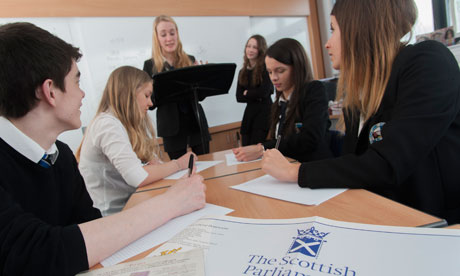
Pupils at Glasgow’s Douglas Academy debate Scotland’s independence ahead of next year’s vote. Photograph: Martin Hunter
Rosie Duthie and Euan MacIntosh, both 15, have made up their minds on how they plan to vote in next year’s referendum on Scottish independence. For Euan the answer is a clear “yes” because he believes it will be his best guarantee of a free university education. Rosie is a “no”. She says: “We should be arguing that what we think is better for the future of young people in Scotland is better for England too and for the European Union.”
By RORY REYNOLDS AND JACKIE KEMP
Published in The Scotsman newspaper on 29/04/2013 00:00
FOREIGN language learning in Scotland’s schools has dipped to “worrying” new levels, education experts warned last night. The warning that the decline will have an negative impact on Scotland’s standing in the world came after it emerged that only about one in ten S5 pupils is taking foreign language courses.
An analysis of education statistics by The Scotsman has found the number of Higher course entrants for modern languages has fallen by nearly a quarter over the past 20 years, from 10,179 to just under 7,887 in 2011.
It’s difficult, unfamiliar, and far from a traditional educational choice. So why are more Scottish pupils bucking the UK trend and venturing out of their comfort zone to study Mandarin? Jackie Kemp speaks to some of the people involved in the pursuit of oriental excellence. From The Scotsman April 29 2013

A group of girls in brightly coloured silk costumes are conversing animatedly in Mandarin – performing a short play for visitors to their school, Leith Academy, Edinburgh. The city comprehensive’s staff are clearly proud of this high-achieving group of six girls, all the children of immigrants from Africa, Asia and diverse parts of Europe, who earlier this year beat stiff competition to make it to the finals of the British Council’s Chinese-speaking competition, for the second time in a row.
T his poem is one of the best-read things on my site. A poem. White out with nuns.You coming?Swirling snowfall makes the world go blankUnnavigable nothingnessAnd through it, the silent…
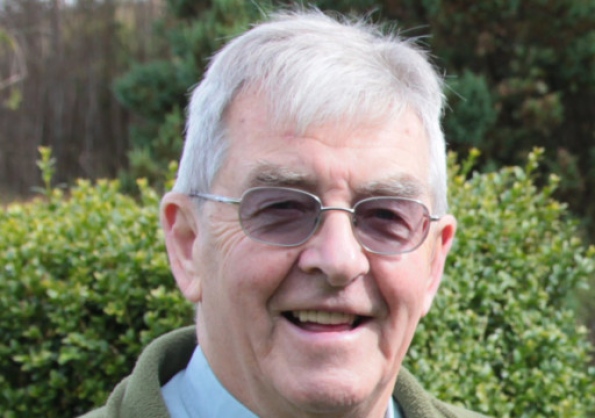
Born: 29 September, 1934, in Liverpool. Died: 26 December, 2012, in Edinburgh, aged 78
Father Edward McSherry – known to everyone as “Father Ted” – was parish priest of St Mary’s Star of the Sea in Leith, Edinburgh. At the time of his death he was working and leading a full life, having recently returned from a visit to South America.
At his funeral, the church was packed with mourners, many of whom had travelled for long distances to mark the passing of this popular priest and to give thanks for what was described as a “simple life – and in the end he died as he lived – very simply”
A version was published in The Scotsman Wednesday 31 October 2012. This sentence did not appear in the Scotsman article
“Relate this week said that large numbers of young people are ascribing problems with intimacy and relationships to their early introduction to the porn industry. Covering this, Radio One newsbeat featured a young woman discussing how her university boyfriend insisted on having rough anal sex with her while watching porn on a handheld device. She said she thought she was “weird” for not enjoying it.”
I was saddened but not surprised by a Plymouth University survey published earlier on this week showing that it has become “common practice” for children to view pornography from age 11. The academics involved called for sex education in schools to include pornography.
Jackie Kemp’s opinion piece on National Theatre show “this House” from “The Scotsman”, published Friday 12 October 2012
A CRUCIAL period for Scotland has been virtually erased from history in a play about Labour’s bid to stay in power in the 70s, writes Jackie Kemp
From The Herald, April 15, 2013.
ARNOLD Kemp, a former editor of The Herald, was toasted as “one of Scotland’s finest ever journalists” during an event to celebrate his life at the Aye Write! Festival in Glasgow.
TRIBUTE: Robin McKie, Jackie Kemp, Julie Davidson and Magnus Llewellin celebrate Arnold Kemp at the Aye Write! festival. Picture: Gordon Terris arnold kemp: Editor of The Herald between 1981 and 1994.
Robin McKie, The Observer’s science correspondent, made the tribute during a wide-ranging, amusing and at times surprising debate that was prompted by his life and work.
Mr Kemp, who died suddenly in 2002 aged 63, would have loved the conversation.
Rosemary Goring’s take on the Creative Scotland debate from the Herald Saturday arts section September 22, 2012
“There is no such thing as art. There are only artists,” said E H Gombrich in The Story of Art. It’s a dictum that the architects of Creative Scotland should have noted. Much of the firestorm that has engulfed that beleaguered institution of late might have been averted if its apparatchiks had had the wisdom and humility to appreciate that the state’s function in funding the arts is solely to disburse money to artists in the most effective and simple manner possible.
Friday comment column from the website allmediascotland 14/9/2012
READING a quality Scottish daily newspaper remains indispensable for anyone who wants to be well-informed about Scottish affairs.

You can buy a copy of “Confusion to our Enemies: selected journalism of Arnold Kemp” direct from me. The cost is £3.99 including postage. Email me if you cannot get this…
The presbyterian minster of the last century has often been caricatured but a box of Arnold Low Kemp’s hand-written sermons which survive in the National Library of Scotland reveal a kindly man attempting to give comfort to his parishioners in troubled times. For some of this period, his own younger son Arnold Kemp was missing though he did survive. (Read the story of this escape here)
On April 15 1934, Arnold Low Kemp gave a sermon in his parish at Longhope on Hoy in the Orkney Islands in which he condemned the treatment of Jews in Germany from the pulpit, asking people to take an interest in matters that may have seemed far away: ”There are people who cannot see beyond themselves, or their kin, or their own country… we share in the amazement at so-called Chrstian Germany ‘s treatment of Jews.”
Just days before Germany invaded Poland, on August 20 1939, Arnold, who was by now the minister at Birse in Aberdeenshire gave a sermon on the text:
When I opened an email on a grim winter’s day offering a holiday house swap for a cottage in the mountains near the border of France and Switzerland, it didn’t take me too long to reply “ooh, quelle bonne idee”. We hadn’t planned a foreign holiday but free accommodation in beautiful surroundings seemed too good to turn down.