Buy “Confusion to our Enemies: the Selected Journalism of Arnold Kemp”
You can buy a copy of “Confusion to our Enemies: selected journalism of Arnold Kemp” direct from me. The cost is £3.99 including postage. Email me if you cannot get this…
A deep dive into why the aesthetics of a book cover shape our reading experience — and whether that judgement is fair.
Read More Buy NowYou can buy a copy of “Confusion to our Enemies: selected journalism of Arnold Kemp” direct from me. The cost is £3.99 including postage. Email me if you cannot get this…
The presbyterian minster of the last century has often been caricatured but a box of Arnold Low Kemp’s hand-written sermons which survive in the National Library of Scotland reveal a kindly man attempting to give comfort to his parishioners in troubled times. For some of this period, his own younger son Arnold Kemp was missing though he did survive. (Read the story of this escape here)
On April 15 1934, Arnold Low Kemp gave a sermon in his parish at Longhope on Hoy in the Orkney Islands in which he condemned the treatment of Jews in Germany from the pulpit, asking people to take an interest in matters that may have seemed far away: ”There are people who cannot see beyond themselves, or their kin, or their own country… we share in the amazement at so-called Chrstian Germany ‘s treatment of Jews.”
Just days before Germany invaded Poland, on August 20 1939, Arnold, who was by now the minister at Birse in Aberdeenshire gave a sermon on the text:
I APPRECIATED the tribute to the late Arnold Kemp by John McKie (alias Myops) incorporated into the Wee Stinker crossword on September 23. It was, as usual, very clever yet…
IT is one of the odd characteristics of our political life that the little things may be more dangerous than the large. Chancellor Norman Lamont may with impunity squander billions on the fruitless defence of sterling. This matters little in the public mind beside his inability to keep his Access bill inside its credit limit.
Perhaps there is some validity in this way of assessing the real person. A character in a Jane Austen novel — one of her succession of charming men who turn out to be scoundrels — was found to be of light and careless disposition because he went to London to get his haircut.
And in London this week another victim of the treacherous turns of political life was making a triumphant return. They used to call him Tricky Dick but, thin as a cheroot, he received a standing ovation from a highly discriminating audience after a speech to a private dinner. Delivered with passion and fluency, without notes of any kind, it could only be described as a tour de force.
When I opened an email on a grim winter’s day offering a holiday house swap for a cottage in the mountains near the border of France and Switzerland, it didn’t take me too long to reply “ooh, quelle bonne idee”. We hadn’t planned a foreign holiday but free accommodation in beautiful surroundings seemed too good to turn down.
Comment piece from the Observer September 2 2012
Batsheva, the Israeli contemporary dance group, should have been one of the hits of this year’s Edinburgh international festival. They got five-star reviews for their witty, sexy and creative show.
“Twice before in my life I have seen Europe go dark and watched the doves of peace having their necks wrung. …”
Playwright and journalist Robert Kemp wrote this celebration of Edinburgh Festival for the Scottish Field in 1967 in the build up the Arab Israeli war. It was one of the last things he wrote as he died later that year.
Festivals are not like people. They never “grow up”. So perhaps it would be a mistake to make too much of the 21st Edinburgh International Festival of Music and Drama (to bestow upon it the full title which leaves out a lot of what happens), except that to say that its continuance for all of those years proves that the original idea was a durable one.
All those years…I , who happen to have seen something of them all, find it difficult to believe that among this years’ audience there will be those who were not born when the early Festivals took place. For them it may seem a venerable institution this Edinburgh Festival Society which some at first predicted would not last for more than a few years.
Comment piece by Jackie Kemp from Scotland on Sunday August 18. `Does any group have the right to demand that a word be redefined?` GAY marriage is a subject which arouses strong emotions. Many support it in the name of equality and human rights – including, apparently, virtually the entire Scottish Cabinet. Some oppose it in the name of religion. Unpleasant names are hurled across the gulf. Surely, however, this is an issue which merits dispassionate consideration.
“He was a man you don’t meet every day.” Literary journalist Alan Taylor remembers Arnold Kemp in a review of the forthcoming anthology ‘Confusion to our Enemies’. From the Scottish Review of Books, August 11, 2012. (Note by JK at the end)
‘Like my fellow countrymen,’ he wrote in The Hollow Drum, the only book he published in his lifetime, ‘I am a confused traveller, but I travel hopefully.’ Kemp was writing in 1993 when devolution, let alone independence, seemed a distant prospect. Separatism, as he surmised, was ‘theoretically remote’, not least because of the attitude of Scottish business community who, then as now, were fearful of any change to the status quo. With uncommon prescience, he noted the power of ‘foreign exchange dealers’ and ‘major industrial and commercial enterprises’ and the influence which they exerted over national governments.
Arnold Kemp’s companion to post-war Scottish politics, ‘The Hollow Drum’, is now available as a Kindle edition from Amazon.The book has been described by Magnus Linklater as “an indispensable guide…
From a Scottish Review special on memorable Scottish holidays. Perhaps the most memorable Scottish holiday I know of was not mine but someone else’s. Once, I took a taxi in Coatbridge driven by a man with a fund of stories. A couple have stuck in my mind. Once he was booked to take an elderly resident to Asda. He waited for her in the car park on a sunny day and when she emerged, hot and laden with bags, she said to him: ‘Take me to Largs, son, take me to Largs’.
This brilliant and informative column appeared in Le Monde on the weekend of June 23/24. Translated by Tiffany Reed and Jackie Kemp
A few days before the European Council of June 28 and 29, the Franco-German discussion is becoming a dialogue of the deaf. The French want to strengthen economic union, the Germans want progress on political union. Neither can hear the other.
The Germans understand the French proposals as a new version of the slogan “Germany will pay”, which reverberated through French politics after the First World War; the French see political integration with Germany as handing over the right to inspect their welfare system.
The lack of mutual understanding is actually a symptom of the underlying problem. The euro is rudderless, a currency union adrift.
This piece appeared in the Scottish Review on May 31, 2012. For legal reasons, the last 2 pars were removed. They are reinstated here. Below is a photo of Creative Scotland execs in Cannes the same week they announced the end of flexible funding. Joyce McMillan knows what she is talking about when it comes to judging performances. The Scotsman’s theatre critic has spent a few years of her life rattling across Scotland on night trains from small towns – the proverbial ‘Shotts in the dark’ – writing reviews. The fact that she knows most of Scotland’s theatre people pretty well and in general is held in respect by them does not interfere with her ability to do her job. She can give a bad review if it’s required.
From the Foreword by Professor Tom Devine: Arnold Kemp, one of the greatest of Scottish journalists and editors of the 20th century, died prematurely at the age of 63 in 2002. He edited The Herald with memorable elan and panache between 1981 and 1994 and his prolific writings also regularly graced the pages of the Scotsman, the Guardian and the Observer in a career which spanned more than four decades from the year he began his first job in journalism in 1959 as a sub-editor on the Scotsman, fresh out of Edinburgh University.
From the Scottish Review March 21, 2012. What would Arnold Kemp have thought of the Leveson inquiry? My father, journalist and editor of this parish, will have been dead 10 years this September. So it was something of a surprise to his nearest and dearest to be called by the Guardian and told that his name had been raised at the Leveson inquiry in connection with a tragic and distressing case surrounding his columnist Jack McLean in the early 90s, a case touched on by Kenneth Roy in his SR column (13 March).
From the Scottish Review, Dec 2011. This piece is also in the Scottish Review anthology, Scottish Review 2012, available from www.scottsihreview.net. It seems bizarre that the Scottish Government has forced through such a wide-ranging set of laws as the Offensive Behaviour at Football and Threatening Communications (Scotland) Bill in the name of anti-sectarianism.
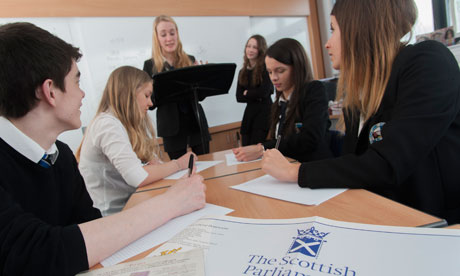
Could Scottish students lose out as university places are offered to English school-leavers with lower A-level grades?
The McEwan Hall and Bristo Square at Edinburgh university. Photograph: Murdo MacLeod for the Guardian
Twice before in my life I have seen Europe go dark and watched the doves of peace having their necks wrung. …”
Robert Kemp on the 21st Edinburgh Festival, from the Scottish Field 1967
Festivals are not like people. They never “grow up”. So perhaps it would be a mistake to make too much of the 21st Edinburgh International Festival of Music and Drama (to bestow upon it the full title which leaves out a lot of what happens), except that to say that its continuance for all of those years proves that the original idea was a durable one.
All those years…I , who happen to have seen something of them all, find it difficult to believe that among this years’ audience there will be those who were not born when the early Festivals took place. For them it may seem a venerable institution this Edinburgh Festival Society which some at first predicted would not last for more than a few years.
“Twice before in my life I have seen Europe go dark and watched the doves of peace having their necks wrung. …”
Robert Kemp on the 21st Edinburgh Festival, from the Scottish Field 1967
Festivals are not like people. They never “grow up”. So perhaps it would be a mistake to make too much of the 21st Edinburgh International Festival of Music and Drama (to bestow upon it the full title which leaves out a lot of what happens), except that to say that its continuance for all of those years proves that the original idea was a durable one.
All those years…I , who happen to have seen something of them all, find it difficult to believe that among this years’ audience there will be those who were not born when the early Festivals took place. For them it may seem a venerable institution this Edinburgh Festival Society which some at first predicted would not last for more than a few years.
To say our teenagers were not keen on a week in a cottage in the far north of Scotland would be like saying Ryan Giggs is not a fan of Twitter. It was not, apparently, their idea of a holiday. The word they used in fact was “nightmare”. But I closed my ears to their girning – second nature now – and insisted they pack plenty of warm clothes and borrow some holiday reading from the school library.
Of course, I told myself, no self-respecting teenager would welcome a week in the Highlands with their parents. I am sure I made the same kind of extravagant complaints myself – but I did enjoy it once I was there.